
US Counter-UAS (Unmanned Aircraft Systems) Market Outlook 2021-2031F
Market Size, Share, Trends, Opportunities, and Competitive Analysis - Segmented by Technology (Detection and Tracking, Electronic Warfare and Soft-Kill, and Kinetic and Directed-Energy Defeat); Platform (Fixed-Site, Mobile and Vehicle-Mounted, and Handheld and Soldier-Worn); End User (Military, Homeland Security and Law Enforcement, and Critical Infrastructure); and Region
US Counter-UAS (Unmanned Aircraft Systems) Market to Surpass USD 9 Billion by 2031, Growing at a 20% CAGR: How Army Budgets, Homeland Protection and Low-Cost Defeat Are Reshaping Procurement
USD 3.0 Billion MARKET SIZE, 2025 | USD 9.1 Billion MARKET SIZE, 2031F | |
35% CAGR, 2021-2025 | 20% CAGR, 2026E-2031F |
US Counter-UAS Market Overview
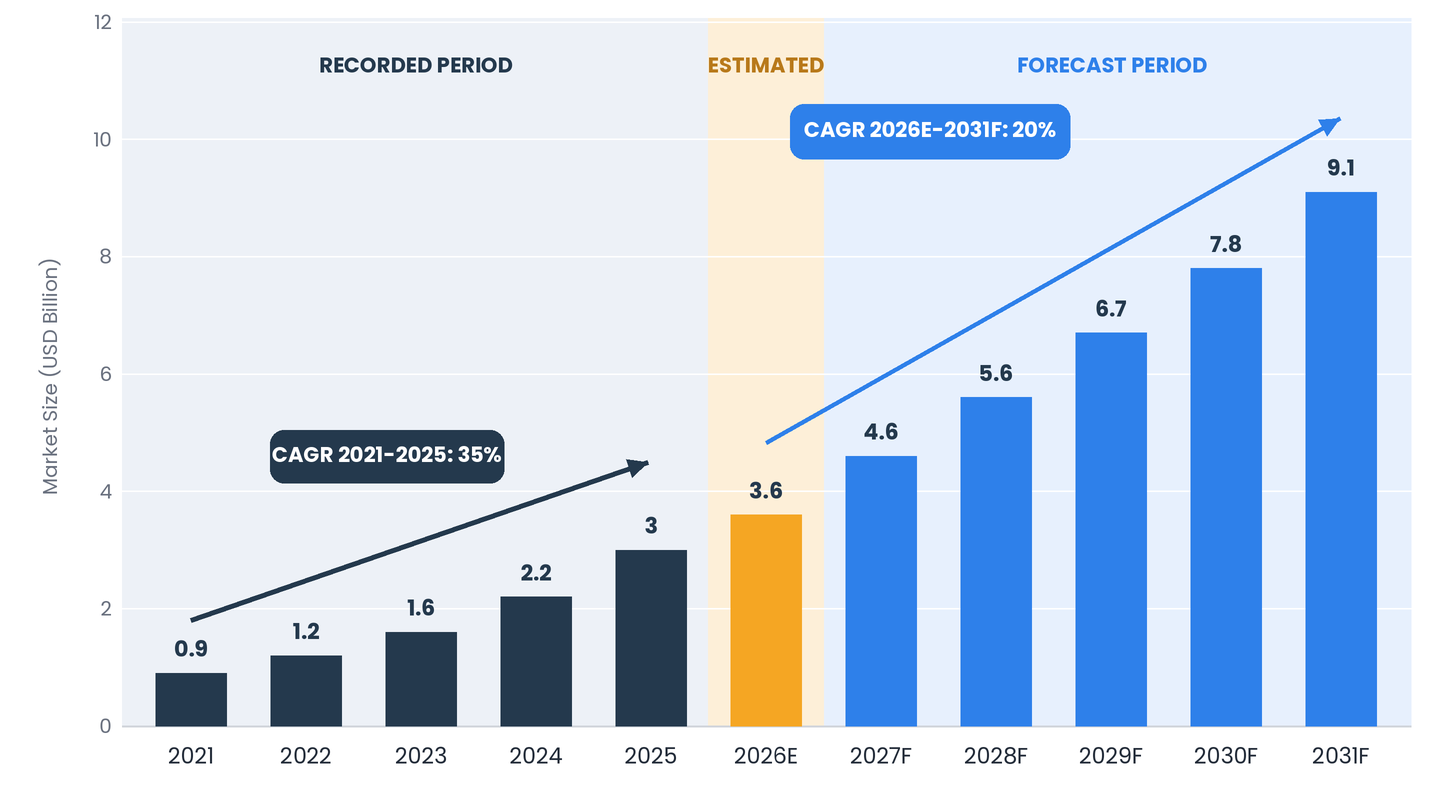
The US is the largest counter-UAS buyer in the world, and spending is moving from experiments to programs of record. Neargoal Consulting estimates the market at about USD 3.0 billion in 2025, rising to USD 3.6 billion in 2026E and USD 9.0 billion by 2031, a 20% CAGR over 2026E-2031F, after a 35% CAGR over 2021-2025. The Army has requested USD 994 million for small counter-UAS in FY2027, up from USD 596 million enacted in FY2026, and the Department of Defense budgeted about USD 3.1 billion for counter-drone technologies in FY2026.
Key Takeaway Spending is growing, but the money is split across many lines and depends on congressional timing. Suppliers that offer low-cost defeat, open integration and fast fielding will win a share as the services standardize on layered defence. |
US Counter-UAS Market at a Glance
MARKET DEFINITION Value of Systems and Services Procured in the US to Detect, Track, Identify and Defeat Unmanned Aircraft (USD Billion) | ||
BASE YEAR / ESTIMATED YEAR 2025 / 2026E | FORECAST PERIOD 2027F-2031F | |
MARKET SIZE, 2025 USD 3.0 Billion | MARKET SIZE, 2026E USD 3.6 Billion | |
MARKET SIZE, 2031F USD 9.0 Billion | RECORDED CAGR, 2021-2025 35% | |
FORECAST CAGR, 2026E-2031F 20% | ARMY SMALL COUNTER-UAS REQUEST, FY2027 USD 994 Million, All Discretionary | |
ARMY SMALL COUNTER-UAS ENACTED, FY2026 USD 596 Million (USD 336 Million Discretionary, USD 260 Million Reconciliation) | DEPARTMENT OF DEFENSE COUNTER-DRONE TECHNOLOGY, FY2026 USD 3.1 Billion | |
DIRECTED ENERGY LINE, FY2027 ARMY REQUEST USD 66 Million, Two Enduring High Energy Laser Systems | LEADING TECHNOLOGY Detection and Tracking | |
FASTEST-GROWING TECHNOLOGY Kinetic and Directed-Energy Defeat | KEY CONSTRAINTS Budget Timing, Legal Authority and Integration | |
Source: Neargoal Consulting Analysis | ||
Market Outlook
Our study estimates the market will grow at a 20% forecast CAGR (2026E-2031F) from USD 3.6 billion in 2026E, after a 35% CAGR over 2021-2025. The base case assumes FY2027 requests are largely funded, with mandatory funding supporting some lines, and homeland and installation protection growing as authorities widen. The FY2027 request is described as more than USD 70 billion for drones and counter-drone capabilities in total, the largest such request to date, which shows how closely the two markets are linked.
Figure 1: US Counter-UAS Market Size, 2021-2031F (USD Billion)
Source: Neargoal Consulting Analysis
Market Dynamics
Growth Drivers
- Army Procurement Growth. The Army’s FY2027 request of USD 994 million covers operational batteries, fixed sites, effectors, soldier-level systems and directed energy, up from USD 596 million enacted in FY2026.
- Large Drone and Counter-Drone Budget. The FY2027 Department of Defense request includes more than USD 70 billion for drone and counter-drone capabilities, against USD 3.1 billion for counter-drone technologies in FY2026.
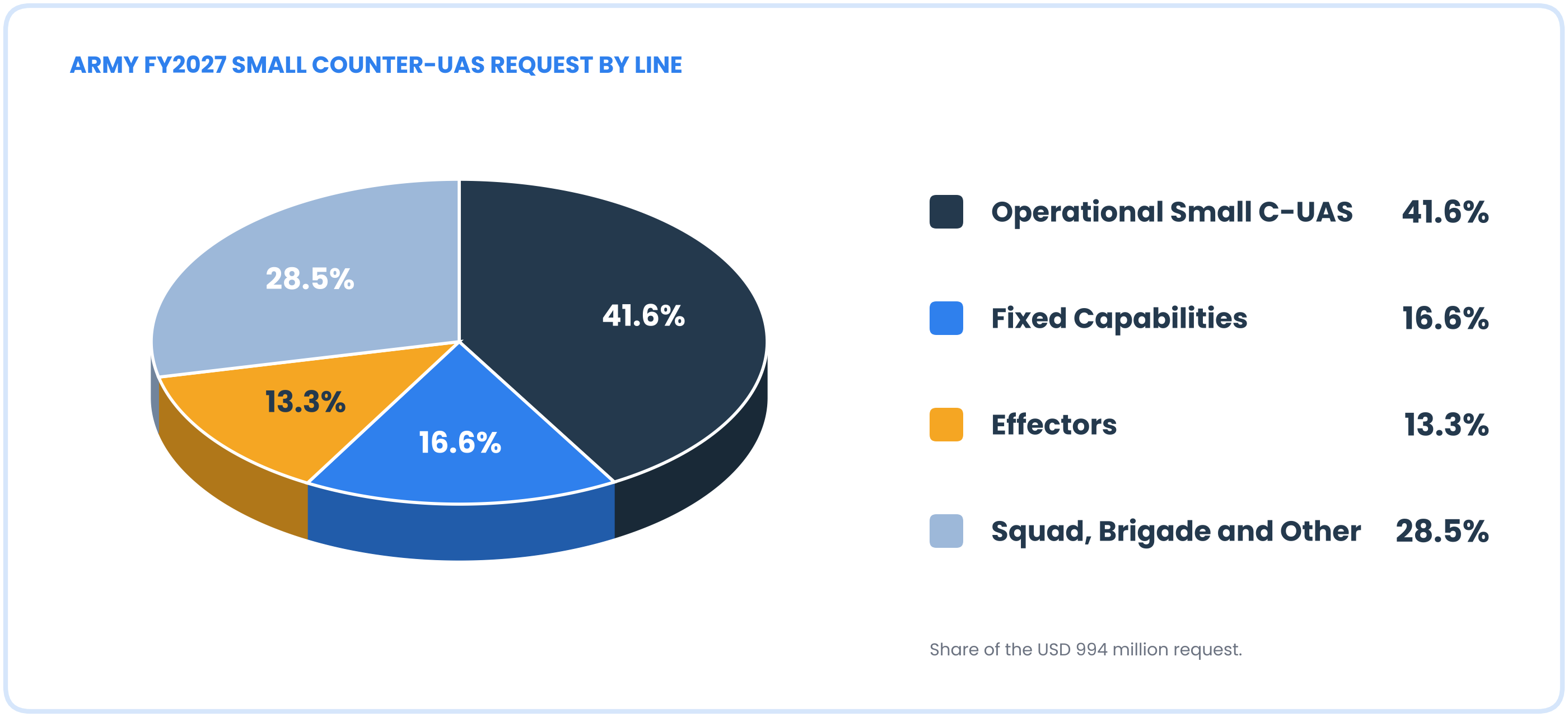
- Homeland and Installation Protection. Fixed capabilities of USD 165 million in the Army request cover homeland and base defence, and interagency coordination is growing.
Restraints
- Budget and Reconciliation Timing. Part of FY2026 funding came from reconciliation, with USD 260 million of the USD 596 million, and requests need congressional approval.
- Legal Authority. Rules limit where and how drones can be disrupted domestically, restricting homeland use.
- Integration and Interceptor Cost. Linking sensors, effectors and command systems is complex, and missile use against cheap drones is costly.
Opportunities
- Directed Energy. The Army requested USD 66 million for two Enduring High Energy Laser systems as a rapid prototyping effort.
- Low-Cost Interceptors. The request includes 800 kinetic and 29 non-kinetic effectors and 24 Next Generation Counter-UAS Missiles, also called Freedom Eagle-1 and made by AeroVironment.
- Soldier-Level and Brigade Systems. USD 108 million for squad and individual systems and USD 80 million for brigade and below protect against Group 1 and 2 drones.
- Command and Control Software. Open architectures connect agnostic sensors and effectors, as in the Family of Counter Unmanned Aircraft Systems.
Policy and Regulatory Landscape
US counter-UAS policy spans defence budgets, interagency task forces and domestic authorities. The FY2027 request needs congressional approval, and FY2026 included both discretionary and mandatory reconciliation funding. Domestic counter-drone authority is limited by law to specified departments and sites, which shapes homeland demand, and the Federal Aviation Administration governs drone operations in civil airspace. A Joint Interagency Task Force, JIATF-401, coordinates counter-drone efforts. The full report assesses how appropriations and authorities affect procurement timing.
Segment Insights
The full report quantifies every segment; the highlights below cover Technology, Platform, and End User.
By Technology
Detection and tracking lead because every defeat system depends on a sensor picture.
Figure 2: Army FY2027 Small Counter-UAS Request by Line
Source: Neargoal Consulting Analysis
By Platform
Fixed-site and mobile systems account for most spending, with the Army requesting USD 414 million for operational small counter-UAS, including batteries, expeditionary mobile platforms and sensors, and USD 165 million for fixed capabilities. Handheld and soldier-worn systems are a smaller but fast-growing segment as squads face Group 1 and 2 drones. Our analysis expects integration of fixed, mobile and soldier-level systems into a single layered network.
By End User
- Military. The largest buyer, led by the Army, with joint and Navy and Air Force programs.
- Homeland Security and Law Enforcement. Border, event and facility protection under limited legal authorities.
- Critical Infrastructure. Energy, airports and government sites seeking detection and mitigation.
Geographic Insights
Demand follows military installations, borders and major events, while the industrial base clusters in a few regions.
- South. Large installations, border areas and defence industry in Texas, Alabama and Florida.
- West. Defence technology firms and testing ranges, including California, Arizona and New Mexico.
- Northeast and Mid-Atlantic. Government agencies, headquarters and systems integrators near Washington.
- Midwest. Manufacturing and component suppliers.
Competitive Landscape
Key participants include Anduril Industries, AeroVironment, RTX, Northrop Grumman, L3Harris Technologies, Lockheed Martin, BAE Systems, SRC, Epirus and Leonardo DRS. Competition rests on integration, cost per engagement and speed of fielding. AeroVironment’s Next Generation Counter-UAS Missile is named in the Army request, with 24 planned.
Anduril Industries | AeroVironment | RTX | Northrop Grumman |
L3Harris Technologies | Lockheed Martin | BAE Systems | SRC |
Epirus | Leonardo DRS |
Key Developments, 2026
- FY2026. Enacted Army small counter-UAS funding totals USD 596 million, of which USD 260 million is mandatory reconciliation funding.
- April 2026. The FY2027 Department of Defense request proposes more than USD 70 billion for drone and counter-drone capabilities.
- May 2026. The Army requests USD 994 million for small counter-UAS in FY2027, across eight lines of effort.
- FY2027 Request. The Army plans 800 kinetic and 29 non-kinetic effectors, 24 Next Generation Counter-UAS Missiles and two laser systems.
What This Means for Decision-Makers
- Armed Services: Standardize on open architectures and buy low-cost defeat options.
- Suppliers: Prove cost per engagement and integrate with agnostic command systems.
- Homeland Agencies: Work within domestic authorities and coordinate through interagency bodies.
- Investors: Track appropriations, not requests, when forecasting revenue.
About the Report
Table 1: US Counter-UAS Market: Report Coverage
Coverage Area | What the Report Covers |
Market Size and Forecast | Revenue (USD Billion) and Program Views, 2021-2031F |
Segmentation | Technology, Platform, End User and Region |
Geography | South, West, Northeast and Mid-Atlantic, and Midwest |
Competition | Primes, Challengers, Programs and Contract Tracking |
Policy and Procurement | Appropriations, Domestic Authorities, Task Forces and Export Rules |
Outlook and Recommendations | White-Space Assessment and Guidance by Stakeholder |
Source: Neargoal Consulting Analysis | |
The research report, US Counter-UAS Market Outlook 2021-2031F - Market Size, Share, Trends, Opportunities, and Competitive Analysis - Segmented by Technology (Detection and Tracking, Electronic Warfare and Soft-Kill, and Kinetic and Directed-Energy Defeat); Platform (Fixed-Site, Mobile and Vehicle-Mounted, and Handheld and Soldier-Worn); End User (Military, Homeland Security and Law Enforcement, and Critical Infrastructure); and Region, covers systems and services procured in the US to detect, track, identify and defeat unmanned aircraft, with a 2025 base year, a 2026E estimate and a 2027F-2031F forecast. It excludes conventional air defence against aircraft and ballistic missiles, and the drones themselves. Market estimates and projections are based on Neargoal Consulting’s proprietary research methodology, exhaustive primary and secondary research.
For questions about report coverage, methodology, suitability, etc.
For requirements beyond the published report