
UAE Counter-UAS (Unmanned Aircraft System) Market Outlook 2021-2031F
Market Size, Share, Trends, Opportunities, and Competitive Analysis - Segmented by Technology (Detection and Tracking, Electronic Warfare and Soft-Kill, and Kinetic and Directed-Energy Defeat); Platform (Fixed-Site, Mobile, and Portable); End User (Military, Homeland Security and Critical Infrastructure, and Civil Aviation and Others); and Region
UAE Counter-UAS Market to Reach USD 760 Million by 2031, Growing at a 24% CAGR: How Combat Experience, Domestic Industry and Layered Defence Are Reshaping Procurement

UAE Counter-UAS Market Overview
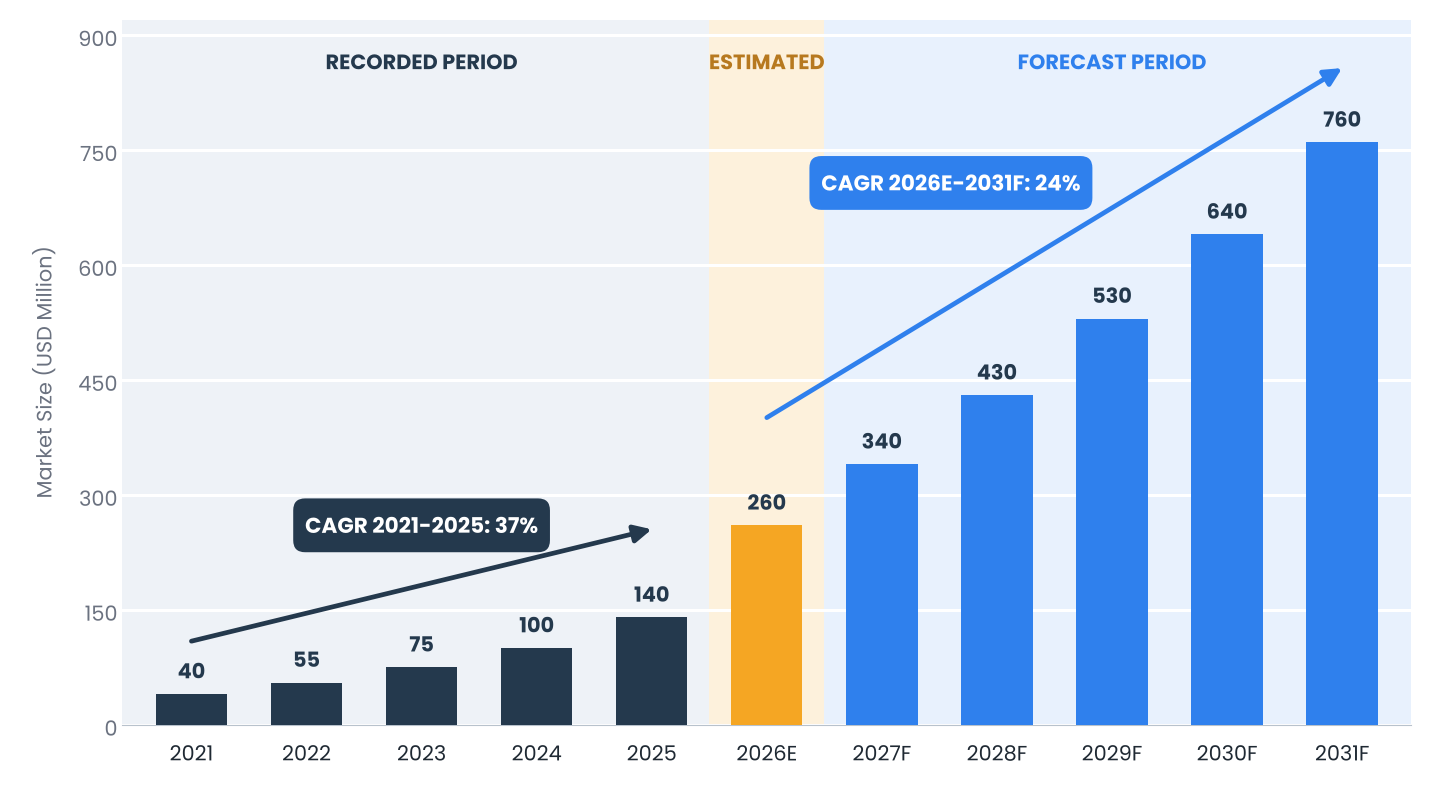
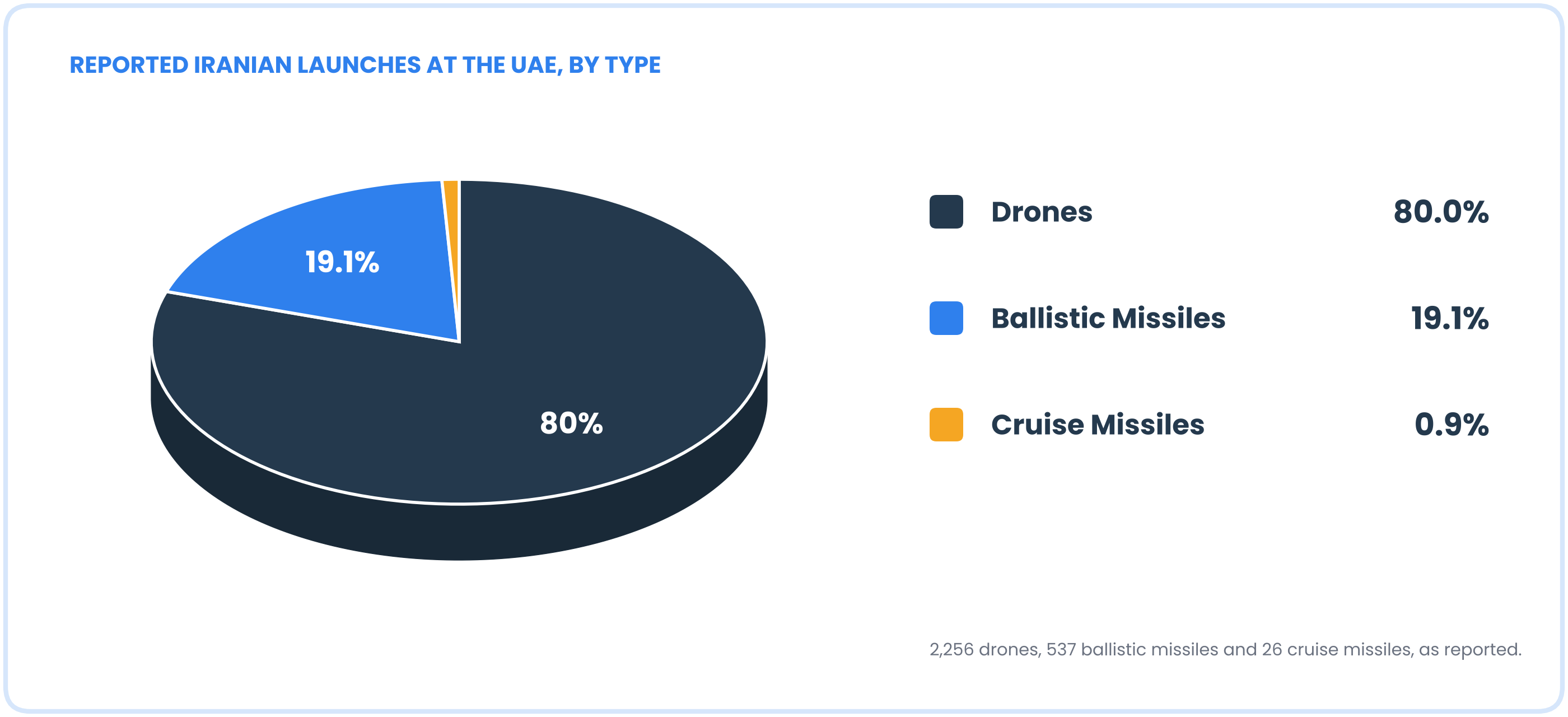
The UAE has moved counter-drone defence from a niche requirement to a national priority. Neargoal Consulting estimates the counter-UAS market at about USD 140 million in 2025, rising to USD 260 million in 2026E and USD 760 million by 2031, a 24% CAGR over 2026E-2031F, after a 37% CAGR over 2021-2025. Reported Iranian strikes on the country included 2,256 drones, 537 ballistic missiles and 26 cruise missiles, and EDGE Group says that its systems, including jammers, helped eliminate more than 85% of the drones, a claim not independently verified.
Key Takeaway Demand is anchored in a domestic defence industry that exports 70% of its output, which means UAE-developed counter-UAS systems can be proven at home and sold abroad. Suppliers that offer integrated sensors, electronic warfare and interceptors at lower cost per engagement will hold the strongest position. |
Table 1: UAE Counter-UAS Market: Key Insights
Metric | Finding |
Market Definition | Value of Systems and Services Procured in the UAE to Detect, Track, Identify and Defeat Unmanned Aircraft (USD Million) |
Base Year / Estimated Year | 2025 / 2026E |
Forecast Period | 2027F-2031F |
Market Size, 2025 | USD 140 Million |
Market Size, 2026E | USD 260 Million |
Market Size, 2031F | USD 760 Million |
Recorded CAGR, 2021-2025 | 37% |
Forecast CAGR, 2026E-2031F | 24% |
Reported Iranian Launches at the UAE | 537 Ballistic Missiles, 26 Cruise Missiles, 2,256 Drones |
Share of Drones Eliminated, Company Claim | More Than 85% |
EDGE Group Annual Revenue | About USD 5 Billion |
EDGE Group Order Backlog | More Than USD 25 Billion |
Leading Technology | Detection and Tracking |
Fastest-Growing Technology | Kinetic and Directed-Energy Defeat |
Key Constraints | Sustained Funding, Integration and Interceptor Cost |
Source: Neargoal Consulting Analysis | |
Market Outlook
Our study estimates the market will grow at a 24% forecast CAGR (2026E-2031F) from USD 260 million in 2026E, after a 37% CAGR over 2021-2025. The base case assumes a one-time uplift in 2026E as stocks are replenished and systems upgraded, followed by steady growth as layered defence, base protection and critical infrastructure programs mature. World military expenditure reached nearly USD 3 trillion in 2025, up 2.9% from 2024, according to the Stockholm International Peace Research Institute.
Figure 1: UAE Counter-UAS Market Size, 2021-2031F (USD Million)
Source: Neargoal Consulting Analysis
Market Dynamics
Growth Drivers
- Demonstrated Threat. The reported launch of 2,256 drones at the UAE, and damage to civilian and energy sites in Abu Dhabi, have raised the priority of layered air defence.
- Domestic Industry and Export Pull. EDGE Group has more than 35 companies, annual revenue of about USD 5 billion and a backlog above USD 25 billion, with about 70% of revenue from exports.
- Soft-Kill Capability. Nationally built jammers and geofencing helped counter drones, and products such as Sign4l SKYSHIELD and NAVCONTROL give a base for lower-cost defeat.
Restraints
- Interceptor Economics. Using costly missiles against inexpensive drones is hard to sustain, which pushes buyers toward jamming, directed energy and gun-based systems.
- Integration Complexity. Linking radars, electronic warfare, interceptors and command systems from different suppliers into one picture is difficult.
- Spending Discipline. EDGE Group’s chief executive expects only single-digit annual revenue growth over three years, a reminder that procurement cycles are uneven.
Opportunities
- Lower-Cost Defeat Systems. Jamming, geofencing and directed energy offer cheaper responses to drone swarms.
- Critical Infrastructure Protection. Energy, ports, airports and urban sites need detection and defeat systems, widening buyers beyond the military.
- Export Platforms. EDGE Group’s agreements with Baykar, Barzan, Indra and EM&E give routes to markets in Africa, Asia, Latin America and Europe.
- Drone-Launched Payloads. EDGE missiles are integrated on Baykar’s TB2 and are being integrated on the AKINCI, creating airborne counter-UAS options.
Policy and Regulatory Landscape
Procurement is led by the UAE Ministry of Defence and executed largely through EDGE Group, which spends about 60% of annual revenue on procurement, or AED 10-12 billion a year, mostly from the local market. The Make it in the Emirates program encourages domestic production, and export controls and partner agreements shape foreign sales. Civil airspace rules govern drone use near airports and critical sites. The full report assesses how procurement routes, localization requirements and export approvals affect suppliers.
Segment Insights
By Technology, detection and tracking lead because every defeat system needs a sensor picture first. The full report quantifies every segment; the highlights below cover Platform and End User.
Figure 2: Reported Iranian Launches at the UAE by Type
Source: Neargoal Consulting Analysis
By Platform
Fixed-site systems protect bases, energy sites and airports and account for the largest share in 2025. Mobile systems mounted on vehicles accompany forces and critical convoys and are expected to grow fastest as armed forces seek flexible coverage. Portable systems serve security teams at events and borders. Our analysis expects fixed and mobile systems to be integrated into a single layered network.
By End User
- Military. The largest buyer, led by the Ministry of Defence and the armed forces.
- Homeland Security and Critical Infrastructure. Energy, ports, airports and urban sites, widening after strikes on infrastructure.
- Civil Aviation and Others. Airport operators and event security.
Geographic Insights
Demand clusters around military bases, energy sites, airports and the capital’s industrial base.
- Abu Dhabi. Home to EDGE Group, major bases, energy infrastructure and the sites damaged in the reported strikes.
- Dubai. Major airports, ports and dense urban sites that need civil airspace protection and event security.
- Sharjah and Northern Emirates. Smaller sites and borders with growing requirements for portable systems.
Competitive Landscape
Key participants include EDGE Group, Israel Aerospace Industries, Baykar, Barzan, Indra, EM&E Group, Rafael, Thales, MBDA and Raytheon, with EDGE leading domestic procurement. Competition rests on integration, cost per engagement and access to export markets. EDGE ranked 37th of 100 globally in the Stockholm International Peace Research Institute’s defence industry list, and its partnerships span Turkey, Qatar, Spain, Brazil and Israel.
EDGE Group | Israel Aerospace Industries | Baykar | Barzan |
Indra | EM&E Group | Rafael | Thales |
MBDA | Raytheon |
Key Developments, 2024-2026
- 2024. EDGE Group and Baykar agree to put Emirati payloads on Turkish drones, and TB2 integration is complete.
- February 2026. EDGE Group and Barzan of Qatar sign an agreement at DIMDEX to combine catalogs and integrate EDGE sensors into Qatari systems.
- May 2026. EDGE Group’s chief executive says single-digit annual revenue growth is expected over the next three years, with exports targeted at Africa, Asia and Latin America.
- 2026. EDGE Group signals that Skyknight is going into production for service in the near term.
What This Means for Decision-Makers
- Armed Forces: Prioritize layered, low-cost defeat options and integrate sensors across services.
- Suppliers: Prove systems in domestic service and use partnerships to reach export markets.
- Infrastructure Operators: Adopt detection and geofencing alongside military systems.
- Investors: Track backlog conversion and procurement timing, not headline threat numbers.
About the Report
Table 2: UAE Counter-UAS Market: Report Coverage
Coverage Area | What the Report Covers |
Market Size and Forecast | Revenue (USD Million) and Program Views, 2021-2031F |
Segmentation | Technology, Platform, End User and Emirate |
Geography | Abu Dhabi, Dubai, Sharjah and Northern Emirates |
Competition | Domestic Industry, International Partners, Programs and Contract Tracking |
Policy and Procurement | Ministry of Defence, Localization, Export Controls and Airspace Rules |
Outlook and Recommendations | White-Space Assessment and Guidance by Stakeholder |
Source: Neargoal Consulting Analysis | |
The research report, UAE Counter-UAS Market Outlook 2021-2031F - Market Size, Share, Trends, Opportunities, and Competitive Analysis - Segmented by Technology (Detection and Tracking, Electronic Warfare and Soft-Kill, and Kinetic and Directed-Energy Defeat); Platform (Fixed-Site, Mobile, and Portable); End User (Military, Homeland Security and Critical Infrastructure, and Civil Aviation and Others); and Region, covers systems and services procured in the UAE to detect, track, identify and defeat unmanned aircraft, with a 2025 base year, a 2026E estimate and a 2027F-2031F forecast. It excludes conventional air defence missiles against aircraft and ballistic missiles, and the cost of the drones themselves. Market estimates and projections are based on Neargoal Consulting’s proprietary research methodology, exhaustive primary and secondary research.
For questions about report coverage, methodology, suitability, etc.
For requirements beyond the published report