Germany Specialty Chemicals Market Outlook 2021-2031F
Market Size, Share, Trends, Opportunities, and Competitive Analysis - Segmented by Product (Performance Additives and Coatings, Electronic and Advanced Materials, Construction and Care Chemicals, and Others); End Use (Automotive, Construction, Electronics, Consumer and Personal Care, and Others); State (North Rhine-Westphalia, Bavaria, Baden-Wurttemberg, Rhineland-Palatinate, and Others); and Region
Germany Specialty Chemicals Market to Reach USD 63 Billion by 2031, Growing at a 3% CAGR: How Energy Costs, Electricity Relief and a Shift to Higher-Value Products Are Reshaping the Sector

Germany Specialty Chemicals Market Overview
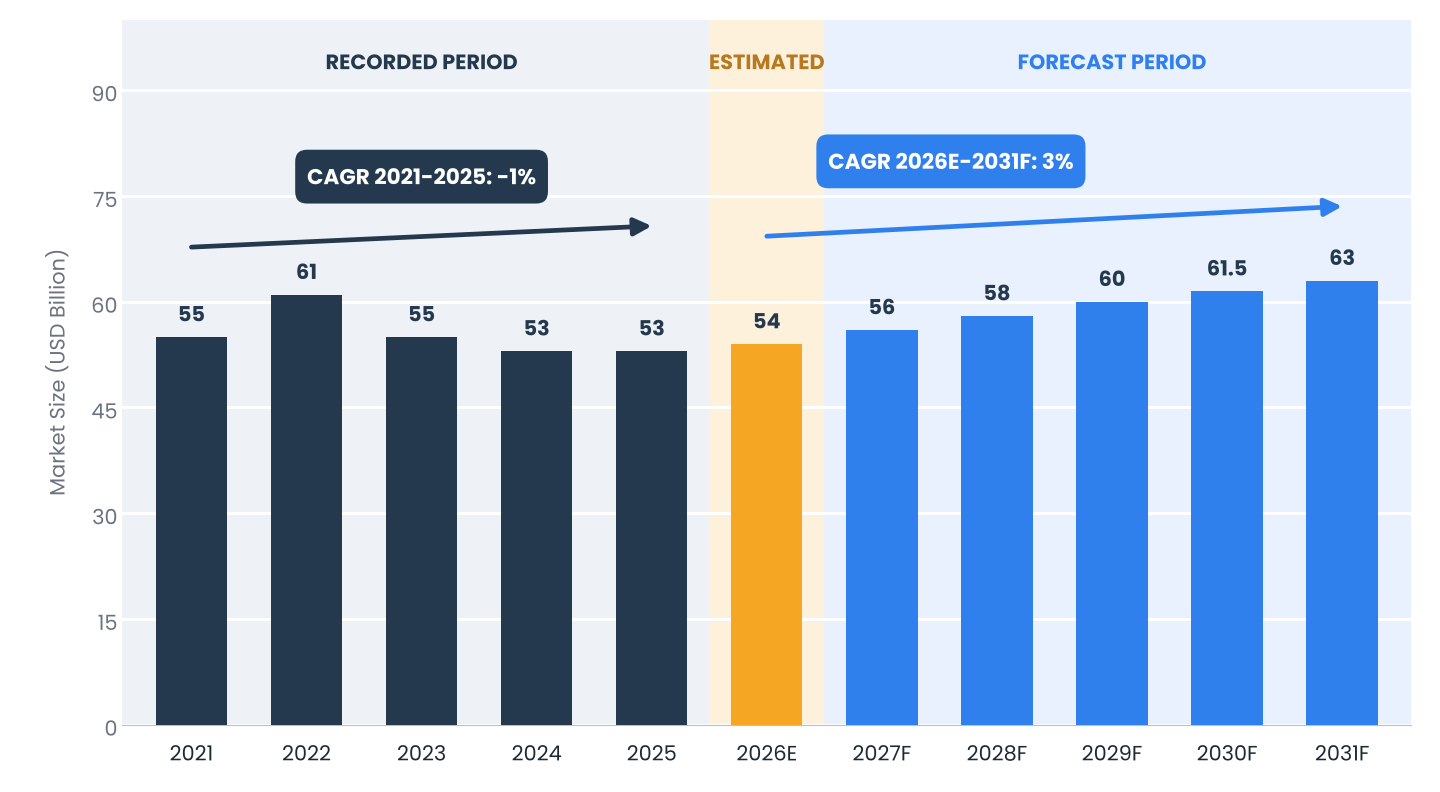
Germany’s specialty chemicals sector is moving from volume to value. Neargoal Consulting estimates the market at about USD 53 billion in 2025, after a -1% CAGR over 2021-2025, rising to USD 54 billion in 2026E and USD 63 billion by 2031, a 3% CAGR over 2026E-2031F. German chemical production fell 3.3% in 2025 and sat about 21% below 2021, and plant utilization was 75.1% in Q1 2026. Specialty producers have held up better than commodity chemicals, helped by technical formulations, customer proximity and electricity relief of up to 5 cents per kWh. The research report quantifies the market by Product, End Use, State and Region and shows where value will move.
Key Takeaway Recovery will be gradual and uneven, led by electronics, construction renovation and sustainability-linked products rather than volume. Producers that localize, cut energy intensity and move up the value chain will hold margins best. |
Germany Specialty Chemicals Market at a Glance
MARKET DEFINITION Value of Specialty Chemicals Produced and Sold by Companies in Germany (USD Billion) | ||
BASE YEAR / ESTIMATED YEAR 2025 / 2026E | FORECAST PERIOD 2027F-2031F | |
MARKET SIZE, 2025 USD 53 Billion | MARKET SIZE, 2026E USD 54 Billion | |
MARKET SIZE, 2031F USD 63 Billion | RECORDED CAGR, 2021-2025 -1% | |
FORECAST CAGR, 2026E-2031F 3% | PLANT UTILIZATION, Q1 2026 75.1% | |
CHEMICAL PRODUCTION, 2025 Down 3.3%, About 21% Below 2021 | INDUSTRIAL ELECTRICITY RELIEF Up to 5 Cents per kWh, 2026-2028 | |
LEADING PRODUCT GROUP Performance Additives and Coatings | FASTEST-GROWING END USE Electronics and Advanced Materials | |
KEY CONSTRAINTS Energy Costs, Weak Demand and Competition from Asia | ||
Source: Neargoal Consulting Analysis | ||
Market Outlook
Our study estimates the market will grow at a 3% forecast CAGR (2026E-2031F) from USD 54 billion in 2026E, after a -1% CAGR over 2021-2025 when energy costs, destocking and weak industrial demand cut volumes. Our analysis expects a gradual recovery from 2027F as inventories normalize, electricity relief takes effect and demand returns in construction and electronics. Incoming orders remain more than 20% below the 2021 level, and the base case assumes no return to 2021 volumes before 2030F.
Figure 1: Germany Specialty Chemicals Market Size, 2021-2031F (USD Billion)
Source: Neargoal Consulting Analysis
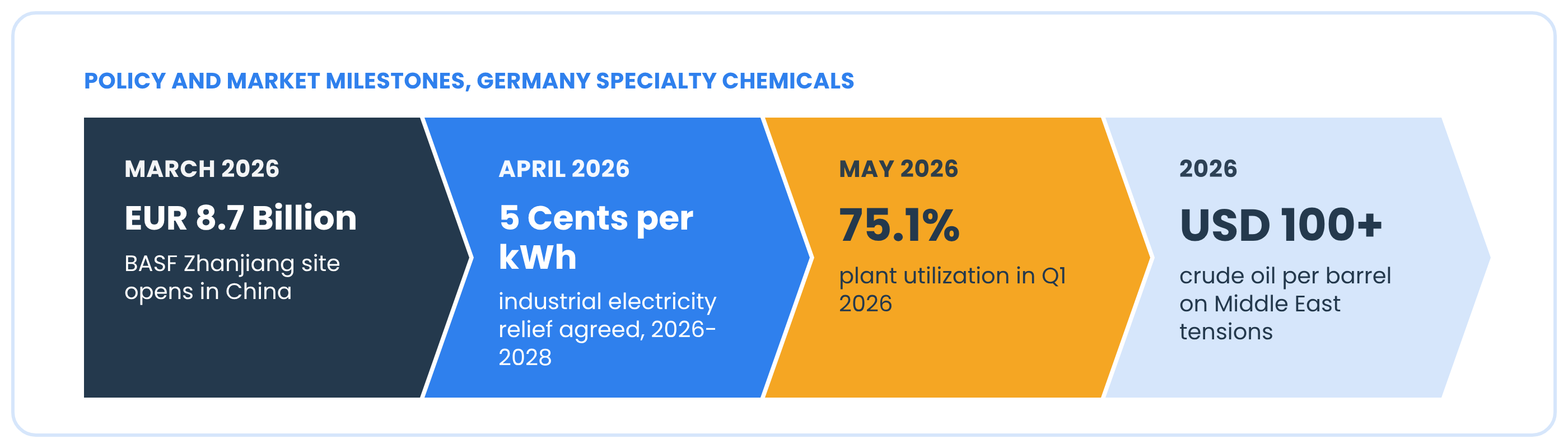
Figure 2: Germany Specialty Chemicals Policy and Market Milestones, 2026
Source: Neargoal Consulting Analysis
Market Dynamics
Growth Drivers
- Electricity Relief. A subsidy caps eligible industrial electricity costs at 5 cents per kWh from 2026 to 2028, with a EUR 3.8 billion budget covering up to 9,500 companies in 91 sub-sectors, including chemical products.
- Shift to Higher-Value Products. Specialty producers are concentrating on electronic materials, battery materials, coatings and care chemicals, where technical performance supports pricing.
- Construction Renovation and Electronics Demand. Energy-efficiency renovation and semiconductor and electronics investment support demand for coatings, adhesives and advanced materials.
Restraints
- High Energy and Raw Material Costs. The industrial power price index stood at 309 points in March 2026, against below 200 in 2009-2020, and naphtha rose almost 18% quarter on quarter in Q1 2026 as crude oil exceeded USD 100 per barrel.
- Weak Demand and Competition. China accounted for 45.7% of global chemical turnover in 2024, and German production was down nearly 19% from 2021 while China’s rose 26.6%.
- Capacity Closures and Investment Shift. Plants amounting to about 25% of German capacity have closed since 2022, and companies are building in Asia, including BASF’s Zhanjiang site opened in March 2026 after investment of EUR 8.7 billion.
Opportunities
- Electronic and Advanced Materials. Semiconductor and battery supply chains in Europe create demand for high-purity chemicals and materials.
- Sustainable Formulations. Low-carbon and bio-based products command premiums and align with customer commitments.
- Process Efficiency and Electrification. Reinvestment of at least 50% of electricity aid into cleaner production supports efficiency and on-site renewables.
- Portfolio Reshaping. Divestments and acquisitions are concentrating producers on higher-margin specialty niches.
Policy and Regulatory Landscape
The federal industrial electricity price scheme, agreed in 2026, caps electricity costs at 5 cents per kWh for eligible companies from 1 January 2026 to the end of 2028, administered by the Federal Office of Economics and Export Control, with at least 50% of aid to be reinvested in cleaner production. The German chemical industry association says the relief covers less than 10% of electricity purchase costs for most companies, since only about half of electricity costs qualify and grid fees, taxes and levies still apply. The EU carbon border adjustment mechanism does not apply to most chemicals, though extension is possible.
Segment Insights
By Product, performance additives and coatings lead on value, supported by automotive, construction and industrial customers. The full report quantifies each segment; the highlights below cover End Use and State.
By End Use
Construction and automotive are the largest end uses, and both are weak, with construction recovering through renovation and automotive depending on electric vehicle demand. Electronics is the fastest-growing end use, supported by semiconductor and battery investment, while consumer and personal care provide stable demand. Our analysis expects electronics and advanced materials to gain share from 2027F.
By State
- North Rhine-Westphalia. The largest chemical state, anchored by the Rhine-Ruhr cluster.
- Bavaria and Baden-Wurttemberg. Specialty and electronics-linked production close to automotive and engineering customers.
- Rhineland-Palatinate. Home to large integrated sites such as Ludwigshafen.
- Saxony-Anhalt and Other States. Eastern clusters with newer investments and lower site costs.
Geographic Insights
Production is concentrated in integrated chemical parks, and regional strength reflects proximity to raw materials, ports and customers.
- North Rhine-Westphalia. Largest by output, with dense raw material and customer networks.
- Rhineland-Palatinate. Home to the largest integrated site, with exposure to restructuring.
- Bavaria. Specialty production for electronics, construction and consumer end uses.
- Saxony-Anhalt. Eastern chemical clusters with scope for new investment.
Competitive Landscape
Key participants include BASF, Evonik, Lanxess, Wacker Chemie, Merck KGaA, Symrise, Covestro, Altana and Heraeus. Competition is shifting from scale to technical differentiation, with producers closing or consolidating commodity-linked assets and focusing on specialty niches. Companies are also expanding in Asia and North America, where energy costs and demand growth are more favorable.
BASF | Evonik | Lanxess | Wacker Chemie |
Merck KGaA | Symrise | Covestro | Altana |
Heraeus | Fuchs |
Key Developments, 2025-2026
- March 2026. BASF opens its Zhanjiang site in China after investment of EUR 8.7 billion.
- April 2026. The federal government agrees an industrial electricity price relief of up to 5 cents per kWh for 2026-2028 with a EUR 3.8 billion budget.
- May 2026. The German chemical industry association reports Q1 2026 sales of EUR 50.9 billion and plant utilization of 75.1%, and withholds a full-year forecast.
- 2026. Energy and raw material costs rise as crude oil exceeds USD 100 per barrel amid Middle East tensions.
What This Means for Decision-Makers
- Producers: Prioritize energy efficiency, niche products and customer proximity over volume.
- Customers: Diversify sourcing and plan for price pass-through.
- Investors: Underwrite on margin resilience and portfolio focus, not on volume recovery.
- Policymakers: Link electricity relief to investment and keep specialty capacity in Germany.
About the Report
Table 1: Germany Specialty Chemicals Market: Report Coverage
Coverage Area | What the Report Covers |
Market Size and Forecast | Value (USD Billion) and Volume Views, 2021-2031F |
Segmentation | Product, End Use, State and Region |
Geography | North Rhine-Westphalia, Bavaria, Baden-Wurttemberg, Rhineland-Palatinate and Other States |
Competition | Producers, Portfolio Moves, Capacity Closures and Investment Tracking |
Policy and Costs | Electricity Relief, Carbon Rules, Energy and Raw Material Costs |
Outlook and Recommendations | White-Space Assessment and Guidance by Stakeholder |
Source: Neargoal Consulting Analysis | |
The research report, Germany Specialty Chemicals Market Outlook 2021-2031F - Market Size, Share, Trends, Opportunities, and Competitive Analysis - Segmented by Product (Performance Additives and Coatings, Electronic and Advanced Materials, Construction and Care Chemicals, and Others); End Use (Automotive, Construction, Electronics, Consumer and Personal Care, and Others); State (North Rhine-Westphalia, Bavaria, Baden-Wurttemberg, Rhineland-Palatinate, and Others); and Region, covers specialty chemicals produced and sold by companies in Germany, with a 2025 base year, a 2026E estimate and a 2027F-2031F forecast. It excludes basic and commodity chemicals, pharmaceuticals and agrochemical active ingredients. Market estimates and projections are based on Neargoal Consulting’s proprietary research methodology, exhaustive primary and secondary research.
For questions about report coverage, methodology, suitability, etc.
For requirements beyond the published report