
China Specialty Chemicals Market Outlook 2021-2031F
Market Size, Share, Trends, Opportunities, and Competitive Analysis - Segmented by Product Type (Electronic Chemicals, High-Performance Polymers and Engineering Plastics, and Coatings, Additives and Others); End-Use Industry (Electronics and Semiconductors, New Energy and Batteries, and Automotive, Construction and Others); Ownership (State-Owned, Private, and Foreign-Invested); and Region
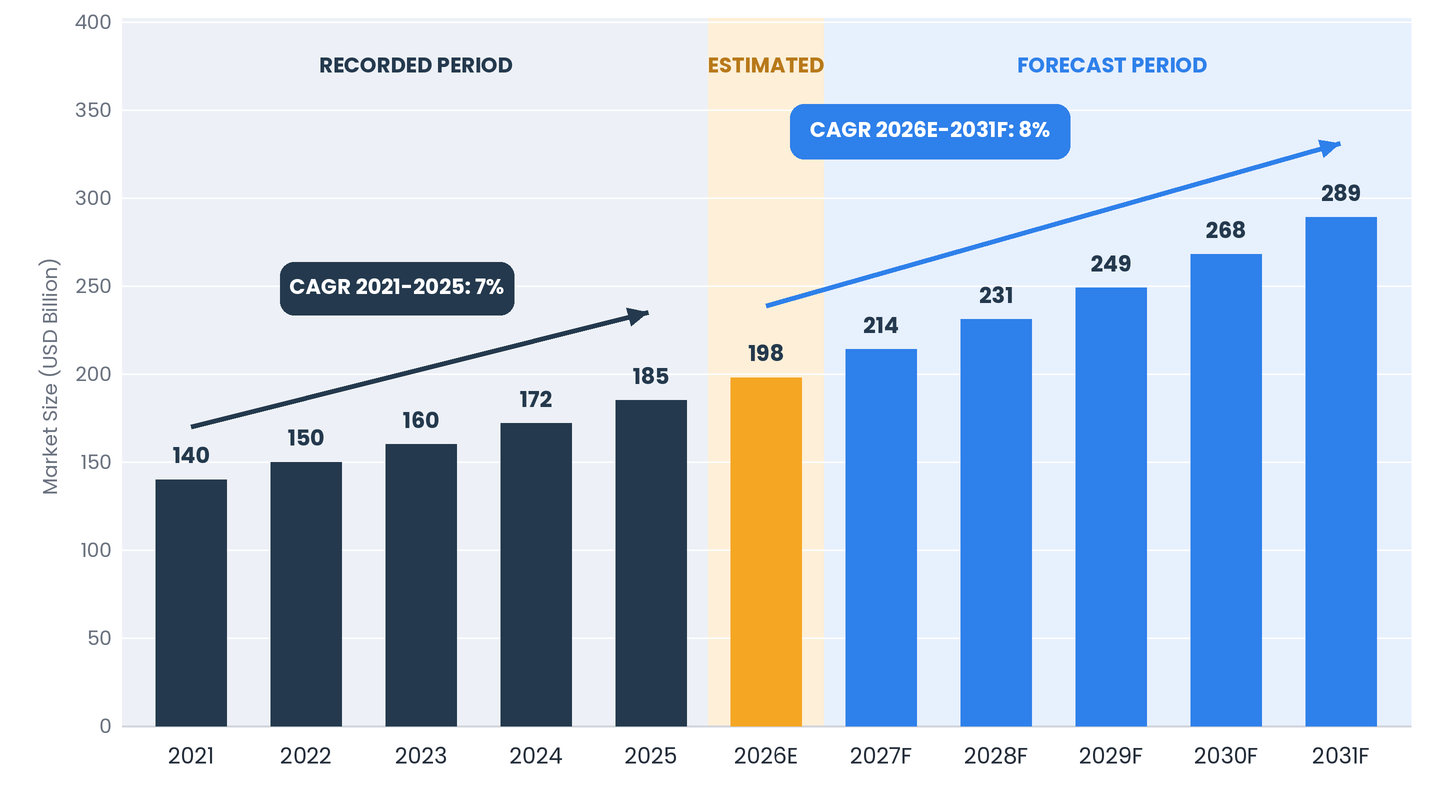
China Specialty Chemicals Market to Reach USD 289 Billion by 2031, Growing at an 8% CAGR: How Self-Sufficiency Goals, Electronics and New Energy Demand Are Shifting the Industry Toward Higher-Value Materials

China Specialty Chemicals Market Overview
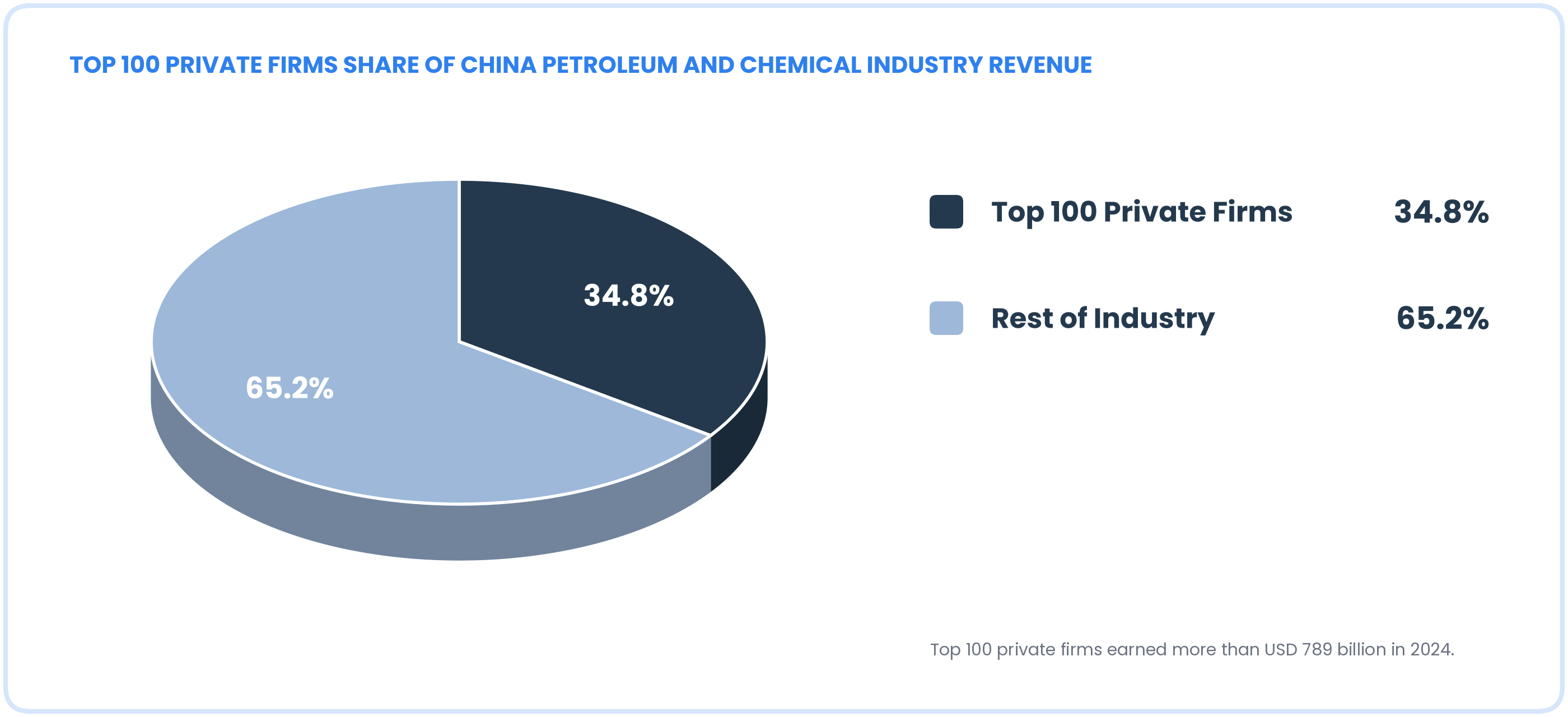
China produces about half of the world’s chemicals, and the policy emphasis is shifting from volume to high-value specialty materials. Neargoal Consulting estimates the China specialty chemicals market at about USD 185 billion in 2025, rising to USD 198 billion in 2026E and USD 289 billion by 2031, an 8% CAGR over 2026E-2031F, after a 7% CAGR over 2021-2025. The top 100 private petroleum and chemical companies earned more than USD 789 billion (CNY 5.67 trillion) in revenue in 2024, and the 15th Five-Year Plan period of 2026-2030 is expected to prioritize new materials and high-value specialty chemicals.
Key Takeaway China’s specialty chemicals market is large and policy-led, so growth depends on closing technology gaps in electronic chemicals and high-performance polymers. Suppliers that qualify with domestic electronics and battery customers will gain share as self-sufficiency goals bite. |
China Specialty Chemicals Market at a Glance
MARKET DEFINITION Value of Specialty and Fine Chemicals Produced and Sold in China, Including Electronic Chemicals, Engineering Plastics, Coatings and Additives (USD Billion) | ||
BASE YEAR / ESTIMATED YEAR 2025 / 2026E | FORECAST PERIOD 2027F-2031F | |
MARKET SIZE, 2025 USD 185 Billion | MARKET SIZE, 2026E USD 198 Billion | |
MARKET SIZE, 2031F USD 289 Billion | RECORDED CAGR, 2021-2025 7% | |
FORECAST CAGR, 2026E-2031F 8% | TOP 100 PRIVATE CHEMICAL COMPANIES, REVENUE 2024 More Than USD 789 Billion | |
LARGE PRIVATE ENTERPRISES, 2024 More Than 30,000, Over 90% of the Total | SPECIALTY SHARE OF CHEMICAL OUTPUT, 2021 PLANS 8.7% | |
SELF-SUFFICIENCY GOAL, KEY SPECIALTIES, 2021 PLANS 75% | PLAN FOR STABILIZING GROWTH, 2025-2026 Growth Above 5% | |
LEADING PRODUCT TYPE High-Performance Polymers and Engineering Plastics | KEY CONSTRAINTS Core Technology Gaps, Overcapacity and Trade Risk | |
Source: Neargoal Consulting Analysis | ||
Market Outlook
Our study estimates the market will grow at an 8% forecast CAGR (2026E-2031F) from USD 198 billion in 2026E, after a 7% CAGR over 2021-2025. The base case assumes steady growth in electronics, new energy and automotive demand, with import substitution adding to volume growth in high-end materials. The Plan for Stabilizing Growth in the Petrochemical and Chemical Industry for 2025-2026 targets growth above 5%, and plans issued in 2021 set a goal of 75% self-sufficiency in the most important specialty chemical products.
Figure 1: China Specialty Chemicals Market Size, 2021-2031F (USD Billion)
Source: Neargoal Consulting Analysis
Figure 2: Top 100 Private Firms Share of China Petroleum and Chemical Industry Revenue
Source: Neargoal Consulting Analysis
Market Dynamics
Growth Drivers
- Self-Sufficiency Policy. Plans issued in 2021 set a 75% self-sufficiency goal for key specialty chemicals and noted that more than 130 new materials could not yet be produced independently.
- Electronics and New Energy Demand. Foreign and domestic investment targets electronic chemicals, high-performance polymers and materials for electric vehicles and renewable energy supply chains.
- Scale and Private Sector Strength. More than 30,000 large private enterprises account for over 90% of the industry, and the top 100 private firms contributed 34.8% of revenue.
Restraints
- Core Technology Gaps. Industry recommendations stress breaking through key core technologies, which shows gaps remain in high-end products.
- Shifting International Market. Risks include changes in the international market and disruption of traditional production models by smart technologies.
- Specialty Share Is Still Low. Specialty chemicals made up only 8.7% of Chinese chemical production in the 2021 plans, so product mix has far to move.
Opportunities
- Electronic Chemicals. Semiconductor and display makers need high-purity chemicals, an area where local supply is growing.
- High-Performance Polymers. Engineering plastics and specialty fibers serve automotive and electronics customers and are priority areas.
- New Energy Materials. Battery materials, including anodes, cathodes and electrolytes, are central to provincial plans in Fujian and elsewhere.
- Digital Manufacturing. Artificial intelligence and big data are seen as new growth drivers for chemical operations.
Policy and Regulatory Landscape
China’s chemical policy is set by national five-year plans, industry association guidance and provincial programs. The 15th Five-Year Plan covers 2026-2030 and is expected to fold private economy development into the national modernization blueprint. The Plan for Stabilizing Growth in the Petrochemical and Chemical Industry for 2025-2026 targets growth above 5%. Provincial plans in Guangdong, Shanghai, Fujian and Shandong list priority products, from electronic chemicals and engineering plastics to battery materials and carbon fiber. The full report assesses how these plans affect investment and import substitution.
Segment Insights
The full report quantifies every segment; the highlights below cover Product Type, End-Use Industry, and Ownership.
By Product Type
High-performance polymers and engineering plastics are the largest group, while electronic chemicals grow fastest.
By End-Use Industry
Electronics and semiconductors are the fastest-growing end-use industry as China expands domestic chip and display production and seeks local supply of high-purity chemicals. New energy and batteries are the second growth driver, followed by automotive, construction and other uses. Our analysis expects electronics and new energy to take a rising share of specialty chemical demand through 2031F.
By Ownership
- State-Owned. Large groups with integrated feedstock and strong access to capital.
- Private. More than 30,000 large enterprises, including leaders such as Wanhua Chemical and Dongyue Group.
- Foreign-Invested. Global firms such as BASF and Syensqo that invest in electronic chemicals, polymers and new energy materials.
Geographic Insights
Clusters sit on the east and south coasts, with provincial plans naming specific products.
- Yangtze River Delta. Shanghai’s plan lists high-performance polyolefins, engineering plastics, adhesives and electronic chemicals.
- Guangdong and South China. Engineering plastics, electronic chemicals, functional membranes and high-performance fibers.
- Fujian. Battery materials, graphene, aramid fibers and ultra-high molecular weight polyethylene.
- Shandong. A Wanhua Chemical research center and carbon fiber industrial hubs in Weihai, Jining, Dezhou and Tai’an.
Competitive Landscape
Key participants include Wanhua Chemical, Dongyue Group, Sinopec, BASF, Syensqo, Xiamen Tungsten New Energy, Shanshan, Saudi Aramco and other state-owned, private and foreign-invested groups. Competition rests on technology, customer qualification and cost. Syensqo’s chief executive said China accounts for half of global chemical output and that the company aims to double its performance in China.
Wanhua Chemical | Dongyue Group | Sinopec | BASF |
Syensqo | Xiamen Tungsten New Energy | Shanshan | Saudi Aramco |
Key Developments, 2021-2026
- 2021. Provincial and national plans set a 75% self-sufficiency goal for key specialty chemicals and an increase in the specialty share of output.
- 2024. The top 100 private petroleum and chemical companies generate more than USD 789 billion (CNY 5.67 trillion) in revenue.
- 2025-2026. The Plan for Stabilizing Growth in the Petrochemical and Chemical Industry targets growth above 5%.
- 2026-2030. The 15th Five-Year Plan is expected to prioritize new materials and high-value specialty chemicals.
What This Means for Decision-Makers
- Domestic Producers: Qualify products with electronics and battery customers and invest in core technology.
- Foreign Firms: Localize electronic chemicals and polymers production and partner with local customers.
- Investors: Track policy plans and qualification milestones, not capacity announcements.
- Customers: Diversify supply while qualifying local products.
About the Report
Table 1: China Specialty Chemicals Market: Report Coverage
Coverage Area | What the Report Covers |
Market Size and Forecast | Revenue (USD Billion) and Volume Views, 2021-2031F |
Segmentation | Product Type, End-Use Industry, Ownership and Region |
Geography | Yangtze River Delta, Guangdong and South China, Fujian, Shandong and Other Regions |
Competition | State-Owned, Private and Foreign-Invested Producers and Plan Tracking |
Policy and Constraints | Five-Year Plans, Provincial Programs, Self-Sufficiency and Trade |
Outlook and Recommendations | White-Space Assessment and Guidance by Stakeholder |
Source: Neargoal Consulting Analysis | |
The research report, China Specialty Chemicals Market Outlook 2021-2031F - Market Size, Share, Trends, Opportunities, and Competitive Analysis - Segmented by Product Type (Electronic Chemicals, High-Performance Polymers and Engineering Plastics, and Coatings, Additives and Others); End-Use Industry (Electronics and Semiconductors, New Energy and Batteries, and Automotive, Construction and Others); Ownership (State-Owned, Private, and Foreign-Invested); and Region, covers specialty and fine chemicals produced and sold in China, with a 2025 base year, a 2026E estimate and a 2027F-2031F forecast. It excludes basic petrochemicals, bulk fertilizers and commodity chemicals, and exports of bulk products. Market estimates and projections are based on Neargoal Consulting’s proprietary research methodology, exhaustive primary and secondary research.
For questions about report coverage, methodology, suitability, etc.
For requirements beyond the published report