
Saudi Arabia E-Commerce Market Outlook 2021-2031F
Market Size, Share, Trends, Opportunities, and Competitive Analysis - Segmented by Business Model (Business-to-Consumer, Business-to-Business, and Consumer-to-Consumer and Others); Product Category (Fashion and Beauty, Electronics and Home, and Grocery, Food Delivery and Others); Payment Method (Cards, Mobile Wallets, and Cash on Delivery and Others); and Region
Saudi Arabia E-Commerce Market to Reach USD 55 Billion by 2031, Growing at a 12% CAGR: How Digital Payments, Quick Commerce and Vision 2030 Are Reshaping Online Retail

Saudi Arabia E-Commerce Market Overview
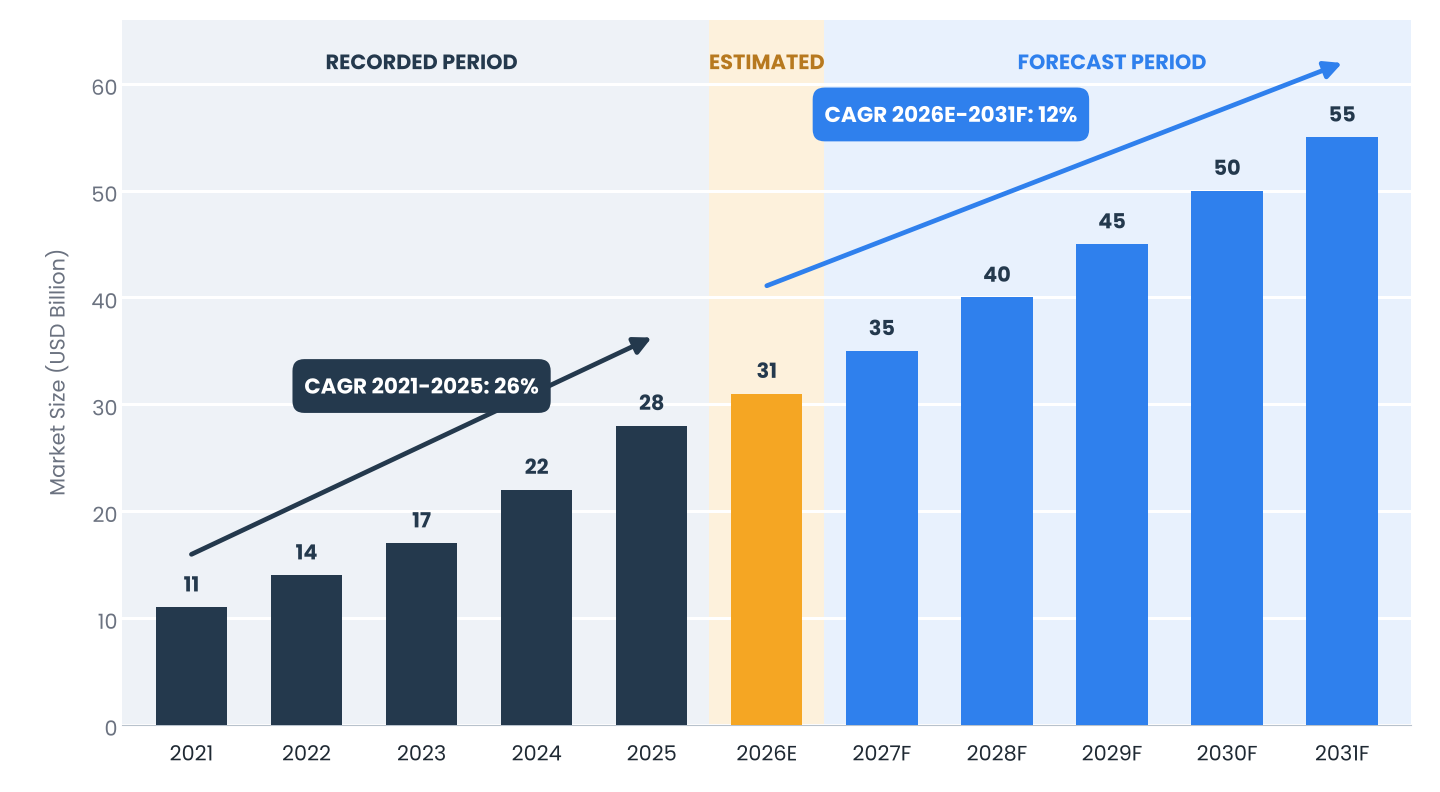
Saudi Arabia is one of the most digitally connected consumer markets in the region. Neargoal Consulting estimates online sales at about USD 28 billion in 2025, rising to USD 31 billion in 2026E and USD 55 billion by 2031, a 12% CAGR over 2026E-2031F, after a 26% CAGR over 2021-2025. Internet penetration is 99%, 5G coverage is 78%, and electronic payments were 85% of retail payments in 2025.
Key Takeaway Connectivity and payments are in place, so growth depends on fulfillment. Platforms that cut last-mile cost and delivery time, especially outside the main cities, will win the next wave of shoppers. |
Saudi Arabia E-Commerce Market at a Glance
MARKET DEFINITION Value of Online Retail and Business-to-Business Goods and Services Sales Transacted Online in Saudi Arabia (USD Billion) | ||
BASE YEAR / ESTIMATED YEAR 2025 / 2026E | FORECAST PERIOD 2027F-2031F | |
MARKET SIZE, 2025 USD 28 Billion | MARKET SIZE, 2026E USD 31 Billion | |
MARKET SIZE, 2031F USD 55 Billion | RECORDED CAGR, 2021-2025 26% | |
FORECAST CAGR, 2026E-2031F 12% | THIRD-PARTY 2025 AND 2026 ESTIMATES USD 27.96 Billion and USD 31.29 Billion | |
INTERNET PENETRATION 99% | 5G COVERAGE 78% | |
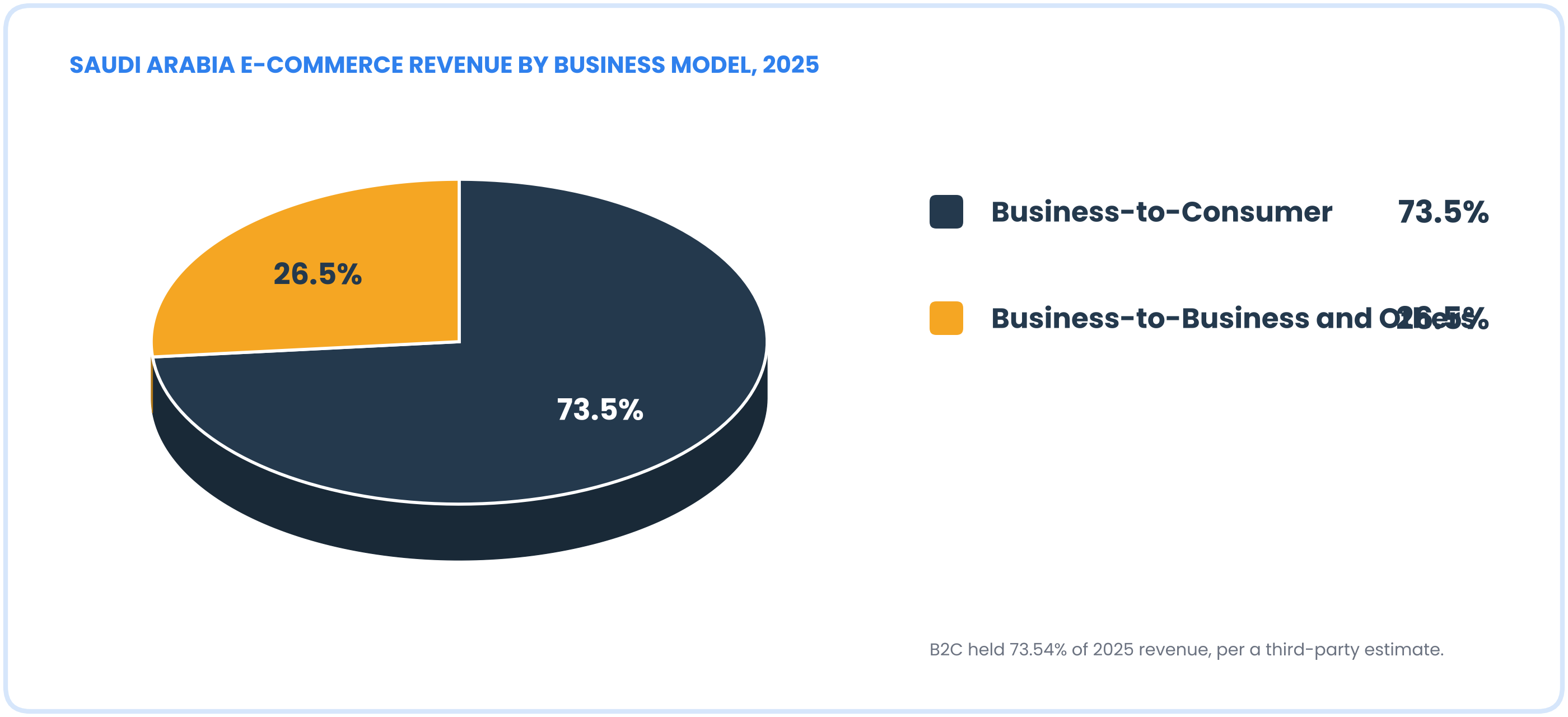
ELECTRONIC SHARE OF RETAIL PAYMENTS, 2025 85% | LEADING BUSINESS MODEL Business-to-Consumer, 73.54% of 2025 Revenue | |
FASTEST-GROWING SEGMENT Business-to-Business and Mobile Wallets | KEY CONSTRAINTS Last-Mile Delivery Cost and Platform Competition | |
Source: Neargoal Consulting Analysis | ||
Market Outlook
Our study estimates the market will grow at a 12% forecast CAGR (2026E-2031F) from USD 31 billion in 2026E, after a 26% CAGR over 2021-2025. The base case assumes growth normalizes as the market matures, with business-to-business and social commerce growing faster than the average, and quick commerce, cross-border orders and mobile wallets taking a rising share of transactions.
Figure 1: Saudi Arabia E-Commerce Market Size, 2021-2031F (USD Billion)
Source: Neargoal Consulting Analysis
Market Dynamics
Growth Drivers
- Digital Infrastructure. Internet penetration of 99% and 5G coverage of 78% support mobile shopping.
- Payments Shift. Electronic payments were 85% of Saudi retail payments in 2025, and the Mada network processed USD 52.6 billion of e-commerce sales in 2024, up 25.8%, according to a third-party estimate.
- Vision 2030 and Small Business Digitization. Infrastructure investment, data protection rules and programs for small businesses support online selling.
Restraints
- Last-Mile Delivery Cost. High delivery costs in rural and low-density areas limit reach.
- Persistence of In-Store and Cash Habits. About 71% of purchase volume still goes to face-to-face transactions, according to payment network data.
- Platform Competition and Margins. Large global and regional platforms compete on price and delivery speed.
Opportunities
- Quick Commerce and Dark Stores. Rapid delivery of groceries and convenience items in dense cities.
- Cross-Border Shopping. Major cross-border platforms reported an 18% increase in international orders.
- Business-to-Business Platforms. Online procurement for small and medium enterprises.
- Logistics and Fulfillment Services. Smart warehouses, automation and delivery networks.
Policy and Regulatory Landscape
Saudi e-commerce is shaped by the Personal Data Protection Law, which clarifies data handling, by the Saudi Central Bank's payment rules and the Mada network, and by Vision 2030 programs that digitize small businesses through the Monsha'at authority. Logistics and customs rules affect cross-border orders and delivery. The full report assesses how payment, data and logistics rules affect cost and growth.
Segment Insights
The full report quantifies every segment; the highlights below cover Business Model, Product Category, and Payment Method.
By Business Model
Business-to-consumer takes the largest share, while business-to-business grows fastest.
Figure 2: Saudi Arabia E-Commerce Revenue by Business Model, 2025
Source: Neargoal Consulting Analysis
By Product Category
Fashion and beauty and electronics and home goods hold the largest shares, supported by regional marketplaces and cross-border platforms. Grocery and food delivery grow quickly through quick commerce and dark stores. Our analysis expects grocery and food delivery to gain share through 2031F.
By Payment Method
- Cards. Credit and debit cards held a 42.62% share, according to a third-party estimate.
- Mobile Wallets. Growing at a 14.71% CAGR, led by STC Pay, Apple Pay and Google Pay.
- Cash on Delivery and Others. Declining but still offered on most major platforms.
Geographic Insights
Online demand concentrates in the largest cities, and delivery reach is the key to growth beyond them.
- Riyadh. The largest market, with dense delivery networks.
- Jeddah and Western Region. Large population and port access.
- Eastern Province. Industrial and consumer markets.
- Other Regions. Growth depends on delivery cost and reach.
Competitive Landscape
Key participants include Amazon.sa, Noon, Jarir Bookstore, Namshi, eXtra, Salla, Zid and Nahdi Medical. Competition rests on assortment, delivery speed, payment options and price. Global and regional marketplaces compete with specialist retailers and merchant platforms.
Amazon.sa | Noon | Jarir Bookstore | Namshi |
eXtra | Salla | Zid | Nahdi Medical |
Key Developments, 2024-2026
- 2024. The Mada network processes USD 52.6 billion of e-commerce sales, up 25.8% from 2023.
- 2025. Electronic payments reach 85% of Saudi retail payments, according to the central bank.
- 2025-2026. A third-party estimate puts the market at USD 27.96 billion in 2025 and USD 31.29 billion in 2026.
- Late 2024. A new quick commerce entrant arrives, adding to dark store competition.
What This Means for Decision-Makers
- Platforms: Invest in last-mile reach and delivery speed outside the largest cities.
- Merchants: Use merchant platforms and social commerce to reach shoppers directly.
- Logistics Providers: Offer automation and same-day coverage.
- Investors: Track delivery economics, not only gross sales.
About the Report
Table 1: Saudi Arabia E-Commerce Market: Report Coverage
Coverage Area | What the Report Covers |
Market Size and Forecast | Revenue (USD Billion) and Order Views, 2021-2031F |
Segmentation | Business Model, Product Category and Payment Method |
Geography | Riyadh, Jeddah and Western Region, Eastern Province and Other Regions |
Competition | Marketplaces, Retailers and Merchant Platforms |
Policy and Constraints | Payments, Data Protection, Logistics and Delivery Cost |
Outlook and Recommendations | Growth Strategy and Guidance by Stakeholder |
Source: Neargoal Consulting Analysis | |
The research report, Saudi Arabia E-Commerce Market Outlook 2021-2031F - Market Size, Share, Trends, Opportunities, and Competitive Analysis - Segmented by Business Model (Business-to-Consumer, Business-to-Business, and Consumer-to-Consumer and Others); Product Category (Fashion and Beauty, Electronics and Home, and Grocery, Food Delivery and Others); Payment Method (Cards, Mobile Wallets, and Cash on Delivery and Others); and Region, covers value of goods and services sold online by businesses to consumers and to other businesses in Saudi Arabia, with a 2025 base year, a 2026E estimate and a 2027F-2031F forecast. It excludes in-store sales, ride-hailing and online services without goods or bookings. Market estimates and projections are based on Neargoal Consulting’s proprietary research methodology, exhaustive primary and secondary research.
For questions about report coverage, methodology, suitability, etc.
For requirements beyond the published report