South Korea Solid-State Battery Market Outlook 2021-2031F
Market Size, Share, Trends, Opportunities, and Competitive Analysis - Segmented by Electrolyte Type (Sulfide, and Oxide and Polymer); Application (Electric Vehicles, Robotics and Consumer Devices, and Aerospace and Others); Cell Format (Pouch, and Prismatic); and Region
South Korea Solid-State Battery Market to Reach USD 350 Million by 2031, Growing at a 48% CAGR: How Samsung SDI, LG Energy Solution and SK On Are Moving All-Solid-State Cells Toward Production

South Korea Solid-State Battery Market Overview
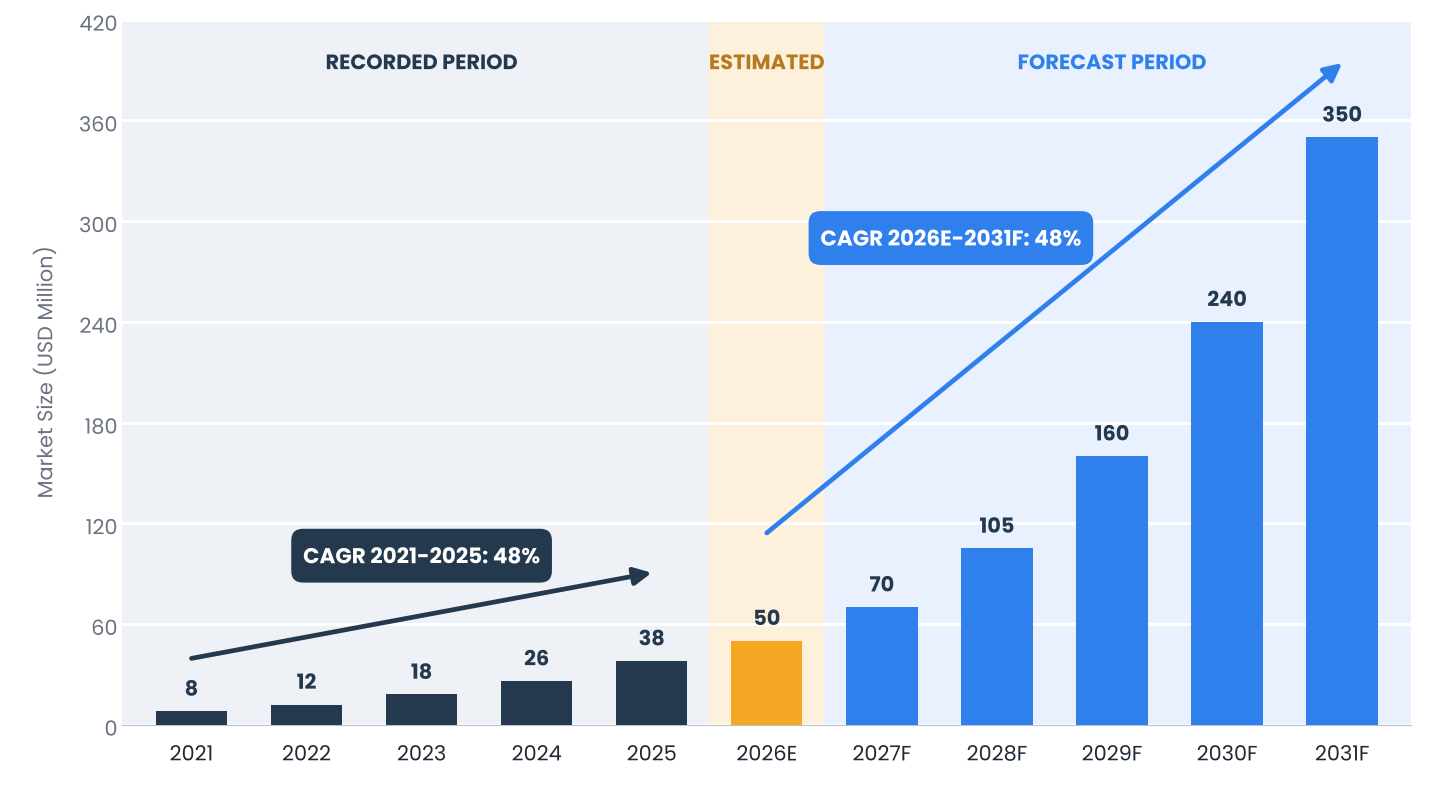
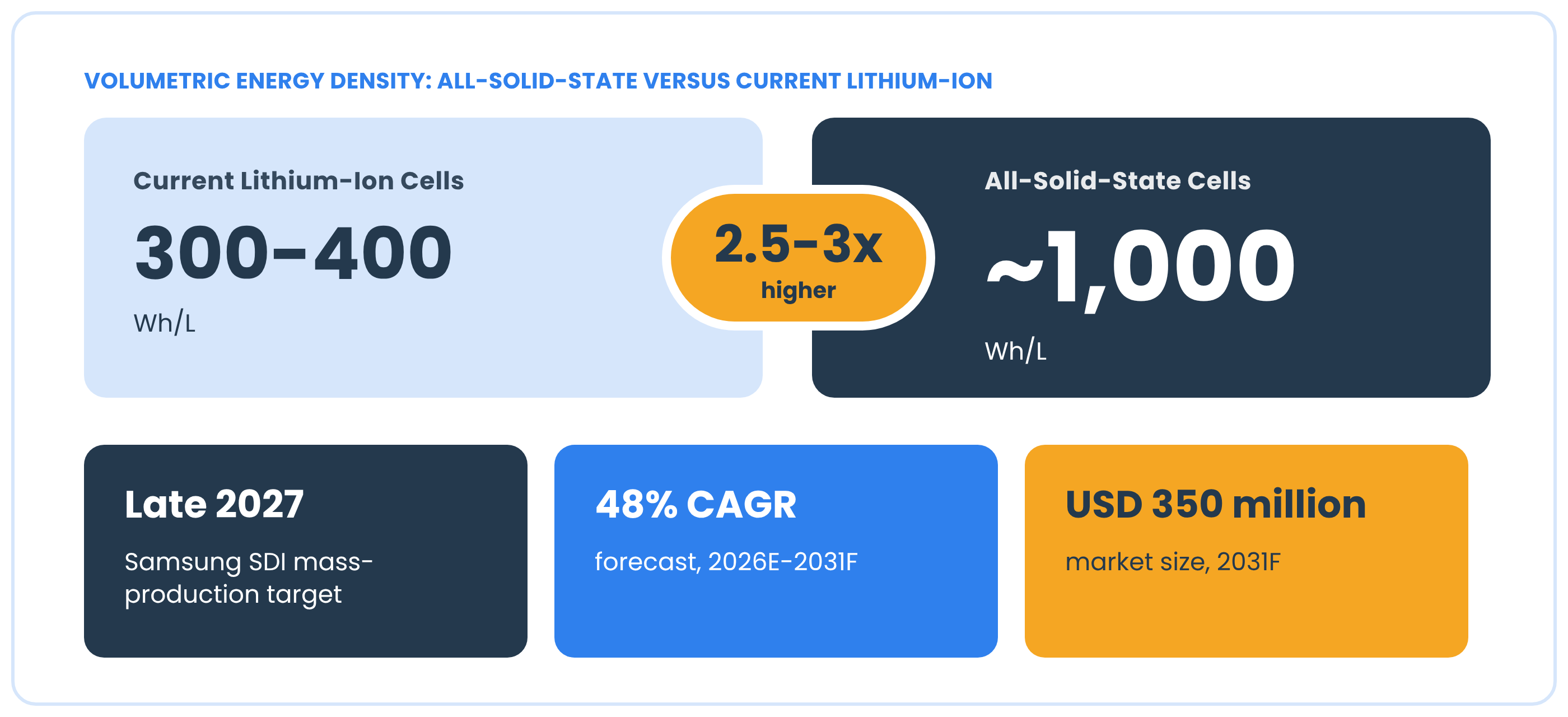
South Korea’s three leading cell makers are preparing all-solid-state batteries for production, with 2027 described as the commercialization turning point. Neargoal Consulting estimates the market at about USD 38 million in 2025, rising to USD 50 million in 2026E and USD 350 million by 2031, a 48% CAGR over 2026E-2031F, after a 48% CAGR over 2021-2025 from a very small base. Samsung SDI is targeting mass production of sulfide-based cells in late 2027, with energy density of about 1,000 Wh/L against 300-400 Wh/L for current lithium-ion cells.
Key Takeaway Korean makers are pitching solid-state cells first at high-value uses such as robotics, aerospace and premium vehicles, where safety and energy density justify higher costs. Volume in electric vehicles depends on yield, sulfide handling and cost against established lithium-ion cells. |
South Korea Solid-State Battery Market at a Glance
MARKET DEFINITION Value of Solid-State Battery Cells and Packs Produced and Sold in South Korea (USD Million) | ||
BASE YEAR / ESTIMATED YEAR 2025 / 2026E | FORECAST PERIOD 2027F-2031F | |
MARKET SIZE, 2025 USD 38 Million | MARKET SIZE, 2026E USD 50 Million | |
MARKET SIZE, 2031F USD 350 Million | RECORDED CAGR, 2021-2025 48% | |
FORECAST CAGR, 2026E-2031F 48% | SAMSUNG SDI MASS-PRODUCTION TARGET Late 2027 (Sulfide-Based) | |
REPORTED ENERGY DENSITY, ALL-SOLID-STATE About 1,000 Wh/L | ENERGY DENSITY, CONVENTIONAL LITHIUM-ION About 300-400 Wh/L | |
NAMED INDUSTRY TURNING POINT 2027 | LEADING ELECTROLYTE TYPE Sulfide | |
LEADING APPLICATION BY 2031F Electric Vehicles and Robotics | KEY CONSTRAINTS Yield, Cost and Sulfide Handling | |
Source: Neargoal Consulting Analysis | ||
Market Outlook
Our study estimates the market will grow at a 48% forecast CAGR (2026E-2031F) from USD 50 million in 2026E, after a 48% CAGR over 2021-2025 from a very small base. The base case assumes sample and pilot-scale revenue in 2026E, first commercial volumes in 2027F-2028F following Samsung SDI’s late-2027 target, and wider vehicle programs from 2029F. Announced targets are plans, not production volumes, and revenue will track yield and customer qualification.
Figure 1: South Korea Solid-State Battery Market Size, 2021-2031F (USD Million)
Source: Neargoal Consulting Analysis
Figure 2: Volumetric Energy Density of All-Solid-State Versus Current Lithium-Ion Cells
Source: Neargoal Consulting Analysis
Market Dynamics
Growth Drivers
- Cell Maker Commitments. Samsung SDI targets mass production of sulfide-based all-solid-state batteries in late 2027, and LG Energy Solution and SK On disclosed their development status at InterBattery 2026.
- Physical AI and Robotics. Samsung SDI unveiled pouch-type samples for humanoid robots and other physical AI uses, and LG Energy Solution named home robots, delivery robots, drones, aircraft and satellites.
- Energy Density and Safety. Energy density of about 1,000 Wh/L compares with 300-400 Wh/L for current lithium-ion cells, and solid electrolytes reduce flammability.
Restraints
- Manufacturing Yield and Cost. Sulfide electrolytes need controlled production environments, and early output is likely to be costly.
- Competition from Established Cells. Lithium iron phosphate and high-nickel lithium-ion cells continue to improve in cost and charging speed.
- Unclear Timelines. Only Samsung SDI has stated a mass-production target in the sources reviewed, and LG Energy Solution and SK On have not published capacity plans.
Opportunities
- Robotics and Drones. Humanoid robots, home robots and drones value energy density and safety and tolerate higher prices.
- Aerospace and Satellites. LG Energy Solution named aircraft and cube satellites among target applications.
- Sulfide Materials and Equipment. Suppliers of lithium sulfide, electrolyte, dry-room and press equipment gain as pilot lines expand.
- Premium Vehicles. First automotive programs are expected to target premium models where range and safety command a premium.
Policy and Regulatory Landscape
South Korea supports battery manufacturing and next-generation battery research through the trade and industry ministry and national research programs. Industry bodies and the Korea Battery Industry Association promote collaboration among cell makers, materials suppliers and automakers. The full report assesses how tax credits, research funding and safety standards affect commercialization timelines, and how government support compares with Japan and China.
Segment Insights
By Electrolyte Type, sulfide systems lead on conductivity and are the focus of Samsung SDI’s program. The full report quantifies every segment; the highlights below cover Application and Cell Format.
By Application
Robotics and consumer devices are the earliest revenue source in 2026E because samples and small-format cells can be sold at premium prices. Electric vehicles are expected to become the largest application by 2031F as premium programs begin, while aerospace and satellites are smaller. Our analysis expects automotive volume to depend on yield and cost.
By Cell Format
- Pouch. Samsung SDI unveiled pouch-type samples for physical AI, suited to compact robots and devices.
- Prismatic. Samsung SDI has developed prismatic all-solid-state batteries for electric vehicles.
Geographic Insights
Activity is concentrated around cell makers’ research and production sites.
- Seoul Capital Area. Gyeonggi Province hosts Samsung SDI’s headquarters and research operations and many materials suppliers.
- Chungcheong. Home to LG Energy Solution’s Ochang plant and a dense supplier base.
- Other Regions. Daejeon hosts SK On research, and southeastern regions host materials and equipment makers.
Competitive Landscape
Key participants include Samsung SDI, LG Energy Solution and SK On, with Posco Future M, EcoPro BM, L&F and Solus Advanced Materials as materials suppliers, and Toyota, Idemitsu Kosan and CATL as international competitors. Competition rests on timing, yield and customer commitments. All three Korean makers disclosed their all-solid-state status at InterBattery 2026 in Seoul on March 11, alongside lithium-metal, bipolar and sodium battery technologies.
Samsung SDI | LG Energy Solution | SK On | Posco Future M |
EcoPro BM | L&F | Solus Advanced Materials |
Logos are trademarks of their respective owners, shown for identification only; no affiliation or endorsement is implied.
Key Developments, 2026-2027
- March 2026. Samsung SDI unveils pouch-type all-solid-state battery samples for physical AI at InterBattery 2026 in Seoul.
- March 2026. LG Energy Solution shows all-solid-state, lithium-metal, bipolar and sodium batteries, with target uses in home robots, drones, aircraft and satellites.
- March 2026. SK On discloses its all-solid-state development status at InterBattery 2026.
- Late 2027. Samsung SDI targets mass production of sulfide-based all-solid-state batteries.
What This Means for Decision-Makers
- Cell Makers: Secure sulfide supply and pilot-line yield before committing to volume.
- Automakers and Robot Makers: Qualify early samples and plan for premium-priced supply.
- Materials Suppliers: Invest in sulfide electrolyte and lithium sulfide capacity ahead of demand.
- Investors: Underwrite on yield and cost milestones, not on announced dates.
About the Report
Table 1: South Korea Solid-State Battery Market: Report Coverage
Coverage Area | What the Report Covers |
Market Size and Forecast | Revenue (USD Million) and Capacity Views, 2021-2031F |
Segmentation | Electrolyte Type, Application, Cell Format and Region |
Geography | Seoul Capital Area, Chungcheong and Other Regions |
Competition | Cell Makers, Materials Suppliers, Automakers and Pilot Line Tracking |
Policy and Funding | Government Support, Research Programs and Safety Standards |
Outlook and Recommendations | White-Space Assessment and Guidance by Stakeholder |
Source: Neargoal Consulting Analysis | |
The research report, South Korea Solid-State Battery Market Outlook 2021-2031F - Market Size, Share, Trends, Opportunities, and Competitive Analysis - Segmented by Electrolyte Type (Sulfide, and Oxide and Polymer); Application (Electric Vehicles, Robotics and Consumer Devices, and Aerospace and Others); Cell Format (Pouch, and Prismatic); and Region, covers solid-state battery cells and packs produced and sold in South Korea, with a 2025 base year, a 2026E estimate and a 2027F-2031F forecast. It excludes conventional lithium-ion cells, semi-solid-state cells and research funding. Market estimates and projections are based on Neargoal Consulting’s proprietary research methodology, exhaustive primary and secondary research.
For questions about report coverage, methodology, suitability, etc.
For requirements beyond the published report