Japan Solid-State Battery Market Outlook 2021-2031F
Market Size, Share, Trends, Opportunities, and Competitive Analysis - Segmented by Electrolyte Type (Sulfide, Oxide, and Polymer and Others); Application (Electric Vehicles, Consumer Electronics, and Industrial and Others); Cell Format (Small-Format and Large-Format); and Region
Japan Solid-State Battery Market to Reach USD 850 Million by 2031, Growing at a 37% CAGR: How Sulfide Electrolytes, Government Funding and Automaker Pilot Lines Are Moving the Technology Toward Production

Japan Solid-State Battery Market Overview
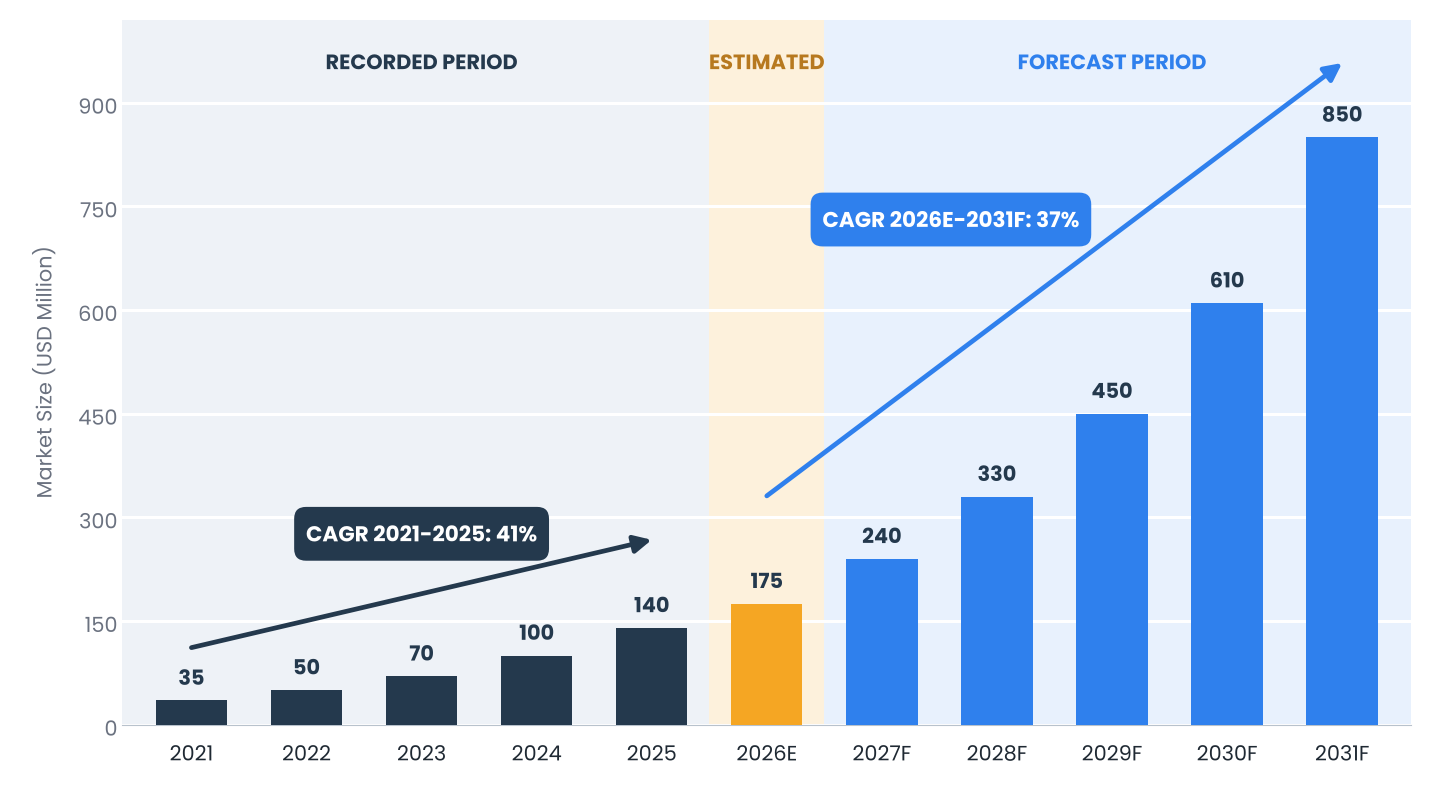
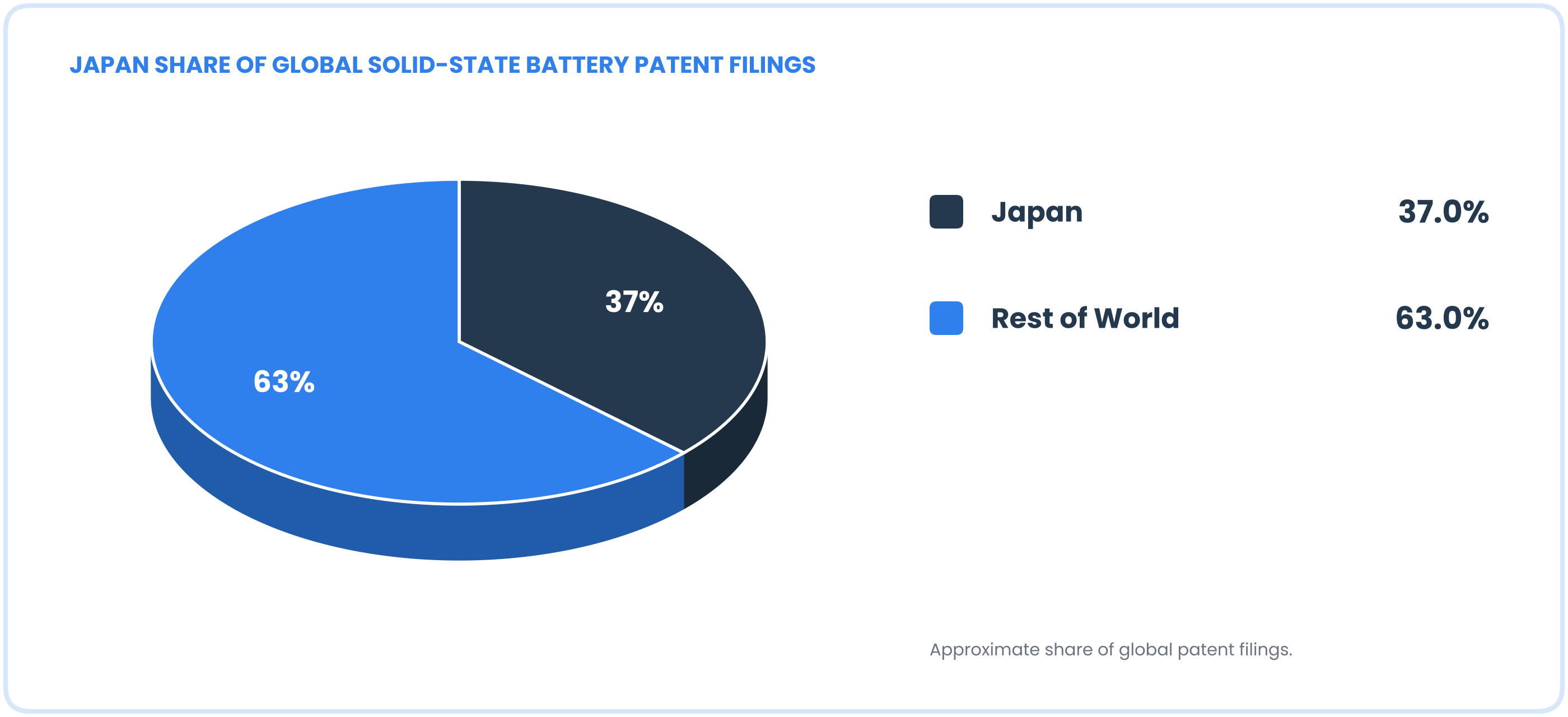
Japan leads the global race to commercialize solid-state batteries, and the technology is moving from laboratories to pilot production. Neargoal Consulting estimates the Japan solid-state battery market at about USD 140 million in 2025, rising to USD 175 million in 2026E and USD 850 million by 2031, a 37% CAGR over 2026E-2031F, after a 41% CAGR over 2021-2025. Japanese companies hold about 37% of global solid-state battery patent filings, and Toyota and Idemitsu Kosan are targeting mass production of all-solid-state battery vehicles in 2027-2028. The research report quantifies the market by Electrolyte Type, Application, Cell Format and Region and shows where early volume will form.
Key Takeaway Early revenue will come from small-format cells and pilot-scale vehicle programs, while large-format automotive volume depends on yield, electrolyte cost and competition from low-cost lithium iron phosphate cells. Suppliers that secure sulfide and lithium sulfide capacity will shape the pace of scaling. |
Table 1: Japan Solid-State Battery Market: Key Insights
Metric | Finding |
Market Definition | Value of Solid-State Battery Cells and Packs Produced and Sold in Japan (USD Million) |
Base Year / Estimated Year | 2025 / 2026E |
Forecast Period | 2027F-2031F |
Market Size, 2025 | USD 140 Million |
Market Size, 2026E | USD 175 Million |
Market Size, 2031F | USD 850 Million |
Recorded CAGR, 2021-2025 | 41% |
Forecast CAGR, 2026E-2031F | 37% |
Government Funding, Five Supply-Chain Projects | USD 660 Million (JPY 105.7 Billion) |
Global Patent Share, Japanese Companies | About 37% |
Automaker Mass-Production Target | 2027-2028 (Toyota with Idemitsu Kosan) |
Leading Electrolyte Type | Sulfide |
Leading Application | Consumer Electronics in 2025, Electric Vehicles by 2031F |
Key Constraints | Yield, Electrolyte Cost and Competition from LFP Cells |
Source: Neargoal Consulting Analysis | |
Market Outlook
Our study estimates the market will grow at a 37% forecast CAGR (2026E-2031F) from USD 175 million in 2026E, after a 41% CAGR over 2021-2025 from a very small base. The base case assumes pilot-scale vehicle programs in 2027F-2028F, with revenue shifting from small-format cells to electric vehicle packs from 2029F as yields improve. Our analysis expects volume to depend on electrolyte supply and manufacturing yield, and treats 2027-2028 targets as a pacing assumption rather than a guarantee.
Figure 1: Japan Solid-State Battery Market Size, 2021-2031F (USD Million)
Source: Neargoal Consulting Analysis
Market Dynamics
Growth Drivers
- Government Funding. Five major solid-state supply-chain projects approved under the Battery Stable Supply Assurance Plan carry subsidies of about USD 660 million (JPY 105.7 billion), with about 18% going to solid electrolytes and lithium sulfide.
- Automaker Commitments. Toyota and Idemitsu Kosan target mass production of all-solid-state battery vehicles in 2027-2028, and Toyota plans about 10 GWh of capacity by 2030. Nissan and Honda have pilot lines.
- Technology Lead. Japanese companies hold about 37% of global filings, and Toyota claims more than 1,000 patents, giving domestic producers a position in sulfide electrolytes.
Restraints
- Yield and Manufacturing Cost. Scaling sulfide electrolytes and cells with high yield remains a challenge, and 2026 priorities are improving yield and quality and expanding critical material capacity.
- Competition from Low-Cost Cells. Lithium iron phosphate cells from Chinese makers, with cell-to-pack designs and ultra-fast charging, set a demanding cost benchmark for automotive use.
- Material Supply. Lithium sulfide and sulfide electrolyte supply is limited, and Idemitsu Kosan’s lithium sulfide unit targets completion in June 2027.
Opportunities
- Sulfide Electrolyte and Lithium Sulfide Supply. Idemitsu Kosan’s Chiba pilot plant, with planned annual capacity of several hundred metric tons, and its lithium sulfide unit of 1,000 metric tons support scaling.
- High-Performance Vehicles. Company claims of energy density of 450-500 Wh/kg, 10-minute charging to 80% and ranges of 1,000-1,200 km make early premium models a natural entry point.
- Consumer and Industrial Cells. Small-format oxide cells for electronics and industrial uses are an earlier revenue stream.
- Equipment and Materials. Dry-room, press and electrolyte equipment suppliers benefit as pilot lines become production lines.
Policy and Regulatory Landscape
Japan’s 2024 Battery Industry Strategy targets commercializing all-solid-state batteries around 2030, and the Ministry of Economy, Trade and Industry funds supply-chain projects through the Battery Stable Supply Assurance Plan. The lithium sulfide unit of Idemitsu Kosan received a JPY 7.1 billion subsidy, and electrolyte mass-production technology was selected for a NEDO Green Innovation Fund project. The government treats solid-state batteries as a strategic technology alongside South Korea, China and the United States.
Segment Insights
By Electrolyte Type, sulfide electrolytes lead on conductivity and are favored for automotive use, while oxide electrolytes serve small-format cells. The full report quantifies each segment; the highlights below cover Application and Cell Format.
By Application
Consumer electronics and industrial uses hold most revenue in 2025, using small-format oxide cells. Electric vehicles are the fastest-growing application, driven by Toyota, Nissan and Honda programs, and are expected to account for the largest share by 2031F. Our analysis expects early vehicle volumes to be limited and aimed at premium models.
By Cell Format
- Small-Format. Established revenue from electronics and industrial uses, with oxide and polymer electrolytes.
- Large-Format. The growth segment, centered on automotive cells and sulfide electrolytes, dependent on pilot line yield.
Geographic Insights
Activity is concentrated in automaker and materials clusters, with research, pilot and production sites close to each other.
Figure 2: Japan Share of Global Solid-State Battery Patent Filings
Source: Neargoal Consulting Analysis
- Chubu. Home to Toyota and its battery development base, anchoring automotive programs.
- Kanto. Hosts materials and electrolyte activity, including Idemitsu Kosan’s Chiba pilot plant, and Nissan and Honda development.
- Kansai. Battery cell and electronic component makers add small-format activity.
- Other Regions. Shizuoka and other sites host electrolyte and materials pilots.
Competitive Landscape
Key participants include Toyota, Idemitsu Kosan, Nissan, Honda, Panasonic Energy, Mitsui Kinzoku, TDK, Maxell and Murata Manufacturing, with Samsung SDI, CATL and BYD as competitors abroad. Competition rests on electrolyte supply, yield and cost, and partnerships between automakers and materials producers are the main route to scale. Idemitsu Kosan ranks first globally for lithium sulfide patent applications and second for sulfide solid electrolyte applications as of the end of 2024.
Toyota | Idemitsu Kosan | Nissan | Honda |
Panasonic Energy | Mitsui Kinzoku | TDK | Maxell |
Murata Manufacturing | Samsung SDI |
Key Developments, 2025-2026
- January 2026. Idemitsu Kosan takes a final investment decision on a large solid electrolyte pilot plant at Chiba, with completion scheduled for 2027.
- Q1 2026. Five major solid-state supply-chain projects are approved with total subsidies of about USD 660 million.
- June 2027. Completion is expected for a 1,000 metric ton lithium sulfide production unit at Idemitsu Kosan.
- 2027-2028. Toyota and Idemitsu Kosan target mass production of all-solid-state battery vehicles.
What This Means for Decision-Makers
- Automakers: Secure electrolyte supply and plan for pilot-to-production yield.
- Materials Suppliers: Invest in lithium sulfide and sulfide electrolyte capacity ahead of demand.
- Investors: Underwrite on yield and cost milestones, not on announced dates.
- Policymakers: Link funding to yield, supply chain and manufacturing milestones.
About the Report
Table 2: Japan Solid-State Battery Market: Report Coverage
Coverage Area | What the Report Covers |
Market Size and Forecast | Revenue (USD Million) and Capacity Views, 2021-2031F |
Segmentation | Electrolyte Type, Application, Cell Format and Region |
Geography | Chubu, Kanto, Kansai and Other Regions |
Competition | Automakers, Cell Makers, Materials Suppliers and Pilot Line Tracking |
Policy and Funding | Battery Strategy, Supply Assurance Plan and Green Innovation Fund |
Outlook and Recommendations | White-Space Assessment and Guidance by Stakeholder |
Source: Neargoal Consulting Analysis | |
The research report, Japan Solid-State Battery Market Outlook 2021-2031F - Market Size, Share, Trends, Opportunities, and Competitive Analysis - Segmented by Electrolyte Type (Sulfide, Oxide, and Polymer and Others); Application (Electric Vehicles, Consumer Electronics, and Industrial and Others); Cell Format (Small-Format and Large-Format); and Region, covers solid-state battery cells and packs produced and sold in Japan, with a 2025 base year, a 2026E estimate and a 2027F-2031F forecast. It excludes conventional lithium-ion cells, semi-solid-state cells and research funding. Market estimates and projections are based on Neargoal Consulting’s proprietary research methodology, exhaustive primary and secondary research.
For questions about report coverage, methodology, suitability, etc.
For requirements beyond the published report