US Biosimilars Market Outlook 2021-2031F
Market Size, Share, Trends, Opportunities, and Competitive Analysis - Segmented by Molecule Class (Monoclonal Antibodies, Fusion Proteins and Others, and Insulins and Supportive Care); Therapy Area (Immunology, Oncology, and Ophthalmology and Others); Channel (Pharmacy Benefit and Retail Pharmacy, Hospital and Infusion, and Specialty Pharmacy); and Region
US Biosimilars Market to Reach USD 42 Billion by 2031, Growing at a 20% CAGR: How Streamlined FDA Pathways, Interchangeability and Patent Expiries Are Opening Biologics to Competition

US Biosimilars Market Overview
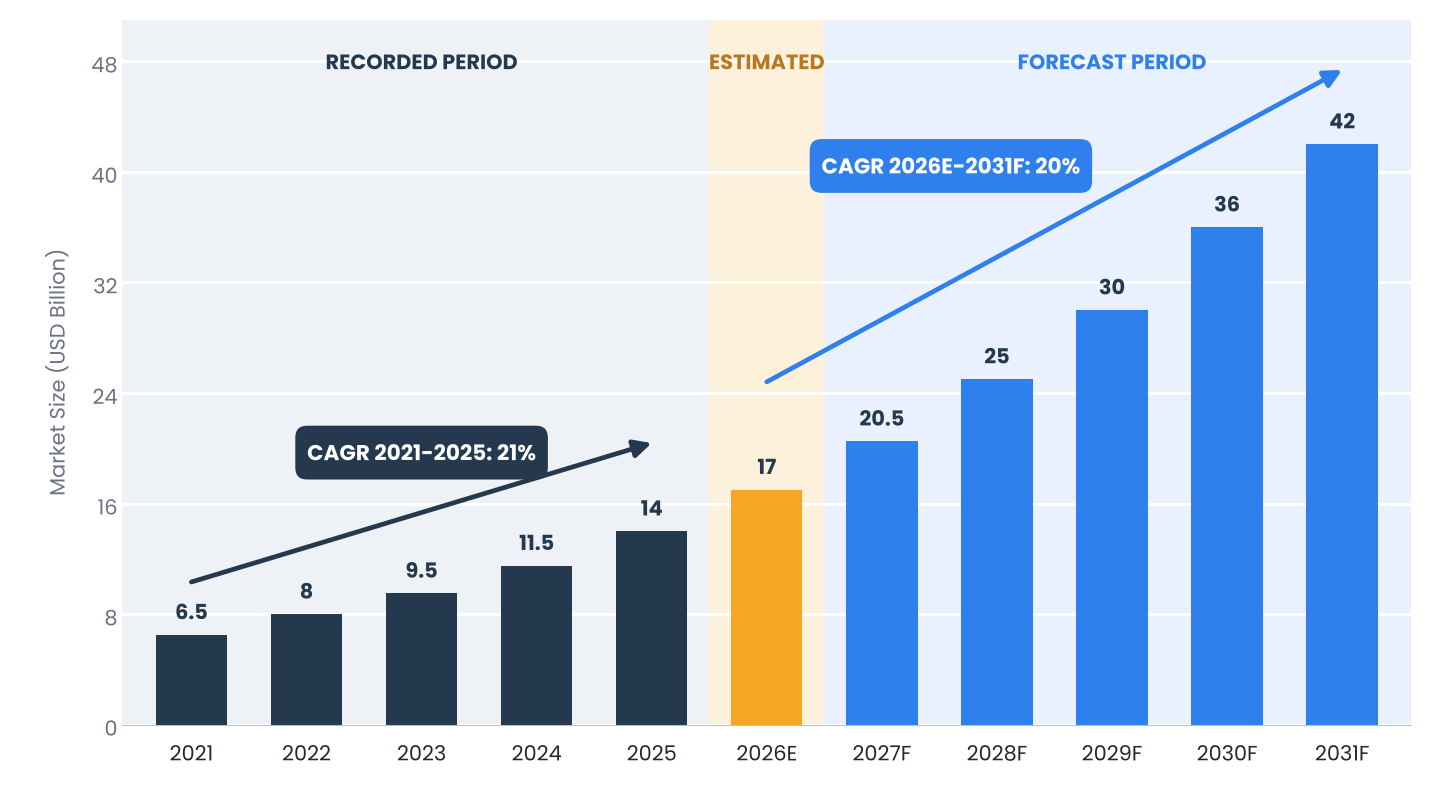
Biosimilars are becoming a core lever for lowering US biologic drug costs. Neargoal Consulting estimates the market at about USD 14 billion in 2025, rising to USD 17 billion in 2026E and USD 42 billion by 2031, a 20% CAGR over 2026E-2031F, after a 21% CAGR over 2021-2025. The FDA has approved 86 biosimilars in total as of May 2026, and policy is moving toward lighter development requirements.
Key Takeaway Approvals are no longer the constraint. Market share will be decided by interchangeability, payer and pharmacy benefit rebate design, and patent settlements, so manufacturers that win formulary position at launch will capture the next wave of expiries. |
US Biosimilars Market at a Glance
MARKET DEFINITION Value of Biosimilar Product Sales in the US at Net Manufacturer Revenue (USD Billion) | ||
BASE YEAR / ESTIMATED YEAR 2025 / 2026E | FORECAST PERIOD 2027F-2031F | |
MARKET SIZE, 2025 USD 14 Billion | MARKET SIZE, 2026E USD 17 Billion | |
MARKET SIZE, 2031F USD 42 Billion | RECORDED CAGR, 2021-2025 21% | |
FORECAST CAGR, 2026E-2031F 20% | FDA-APPROVED BIOSIMILARS 86 in Total as of May 2026 | |
2025 APPROVALS 18 Biosimilars Referencing 10 Molecules | 2025 LAUNCHES 16, Including Eight Referencing Ustekinumab | |
DEVELOPMENT PROGRAMS 135 in FDA Biosimilar Development Program, December 2025 | LEADING THERAPY AREA Immunology | |
FASTEST-GROWING SEGMENT Oncology Antibodies | KEY CONSTRAINTS Patent Litigation, Payer Rebate Design and Pricing Pressure | |
Source: Neargoal Consulting Analysis | ||
Market Outlook
Our study estimates the market will grow at a 20% forecast CAGR (2026E-2031F) from USD 17 billion in 2026E, after a 21% CAGR over 2021-2025. The base case assumes steady launches of denosumab, ustekinumab, aflibercept and tocilizumab biosimilars through 2027F, followed by a step up from 2028F as pembrolizumab and nivolumab lose patent protection. At least seven developers are pursuing a pembrolizumab biosimilar.
Figure 1: US Biosimilars Market Size, 2021-2031F (USD Billion)
Source: Neargoal Consulting Analysis
Market Dynamics
Growth Drivers
- Streamlined FDA Pathway. An October 2025 draft guidance proposes removing the default requirement for comparative efficacy studies, and a March 2026 draft guidance on pharmacokinetic studies could cut costs by up to 50%, or about USD 20 million per program.
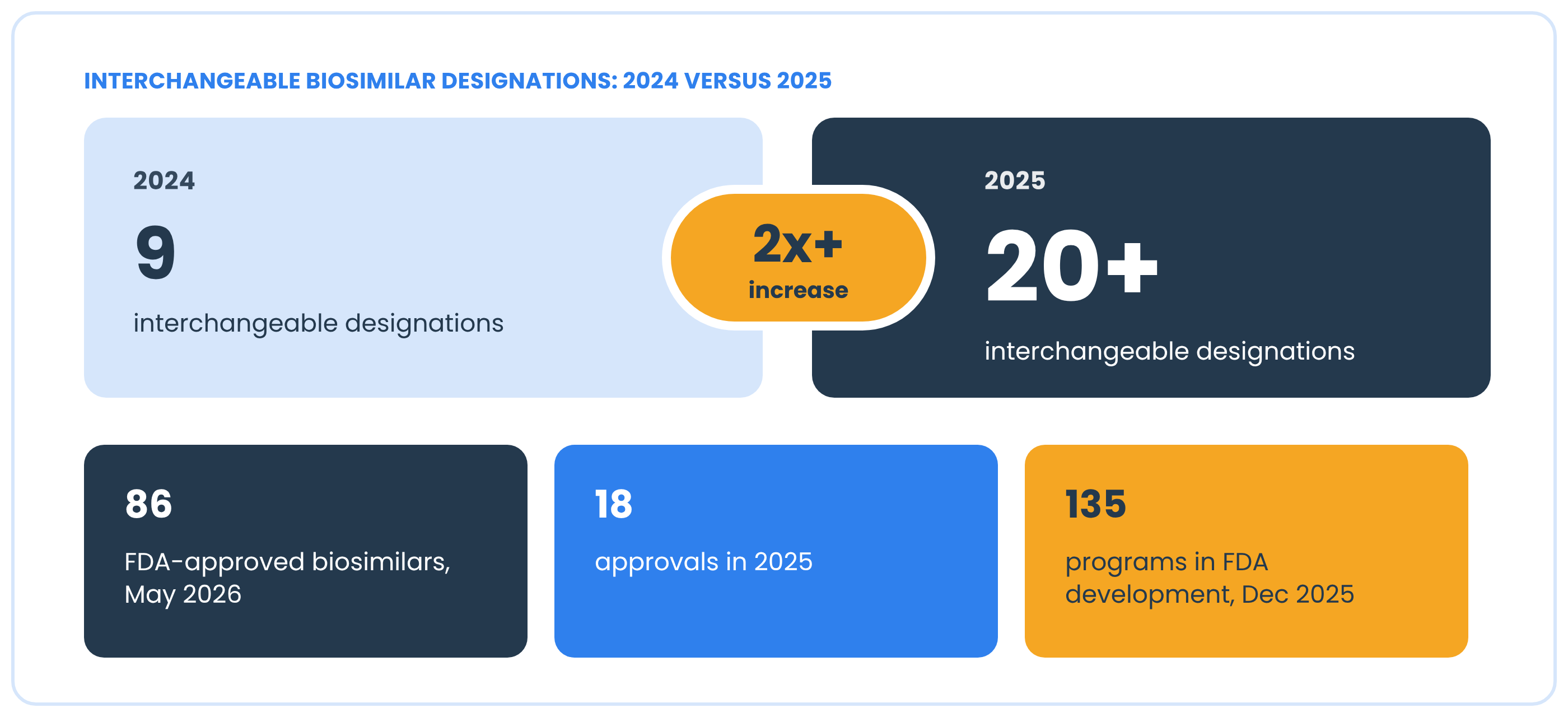
- Interchangeability. More than 20 biosimilars received interchangeable designations in 2025, up from nine in 2024, which allows pharmacist-level substitution in many states.
- Deep Pipeline and Patent Expiries. 135 programs were enrolled in the FDA development program in December 2025, and pembrolizumab and nivolumab are expected to lose patent protection in 2028.
Restraints
- Patent Litigation and Settlements. Reference product sponsors assert large patent portfolios, and several bills target patent thickets and pay-for-delay settlements.
- Payer and Rebate Design. Rebate-based formulary decisions can favor the originator over a lower-priced biosimilar.
- Pricing Pressure. Price erosion and negotiated pricing for reference biologics compress returns for new entrants.
Opportunities
- Oncology Antibodies. Pembrolizumab and nivolumab are the largest expiries in prospect.
- Ophthalmology. Aflibercept and ranibizumab biosimilars are gaining approvals and launches.
- Interchangeable Insulins and Immunology Products. Pharmacy-level substitution supports uptake.
- Private-Label and Co-Branded Models. Partnerships with pharmacy benefit managers can secure volume.
Policy and Regulatory Landscape
The Biologics Price Competition and Innovation Act sets the pathway for biosimilars in the US. The FDA proposed in October 2025 to remove the default requirement for comparative efficacy studies, withdrew its 2015 guidance on demonstrating biosimilarity in March 2026, and finalized promotional labeling guidance in December 2025. Congress is considering bills on patent thickets and interchangeability, and the Inflation Reduction Act negotiates prices for selected biologics. The full report assesses how these rules affect launch timing and pricing.
Segment Insights
The full report quantifies every segment; the highlights below cover Molecule Class, Therapy Area, and Channel.
By Molecule Class
Monoclonal antibodies hold the largest share of sales and the pipeline.
Figure 2: Interchangeable Biosimilar Designations, 2024 Versus 2025
Source: Neargoal Consulting Analysis
By Therapy Area
Immunology leads, supported by ustekinumab and adalimumab launches, while oncology is set to grow fastest as large antibody expiries approach. Ophthalmology adds value through aflibercept and ranibizumab biosimilars. Our analysis expects oncology to take a growing share of sales from 2028F.
By Channel
- Pharmacy Benefit and Retail Pharmacy. Self-administered products where formulary design decides uptake.
- Hospital and Infusion. Products administered in clinics and infusion centers under buy-and-bill reimbursement.
- Specialty Pharmacy. High-touch therapies for complex chronic conditions.
Geographic Insights
Uptake varies by payer structure and state substitution rules rather than by geography alone.
- Northeast. Dense hospital systems and large integrated payers.
- South. The largest patient population with a high share of pharmacy benefit coverage.
- Midwest. Large health systems and employer plans.
- West. Integrated delivery networks and early adopters of interchangeable products.
Competitive Landscape
Key participants include Amgen, Sandoz, Samsung Bioepis, Celltrion, Biocon Biologics, Fresenius Kabi, Teva, Organon, Pfizer and Alvotech. Competition rests on regulatory timing, manufacturing scale, payer contracts and patent settlements. Several developers are building commercial partnerships to reach pharmacy benefit and hospital channels.
Amgen | Sandoz | Samsung Bioepis | Celltrion |
Biocon Biologics | Fresenius Kabi | Teva | Pfizer |
Key Developments, 2025-2026
- October 2025. The FDA issues draft guidance proposing to remove the default requirement for comparative efficacy studies.
- December 2025. The FDA finalizes guidance on promotional labeling for biosimilars and interchangeable products.
- March 2026. The FDA issues draft guidance to streamline pharmacokinetic studies and withdraws its 2015 biosimilarity guidance.
- May 2026. The FDA approves interchangeable golimumab biosimilars, taking total approvals to 86.
What This Means for Decision-Makers
- Manufacturers: Prioritize interchangeable designation and payer contracts alongside approval.
- Payers and Pharmacy Benefit Managers: Review rebate design so lower-priced products can win formulary position.
- Providers: Prepare for buy-and-bill economics as infusion biosimilars scale.
- Investors: Track the 2028 oncology expiries and patent settlement timing.
About the Report
Table 1: US Biosimilars Market: Report Coverage
Coverage Area | What the Report Covers |
Market Size and Forecast | Revenue (USD Billion) and Launch Views, 2021-2031F |
Segmentation | Molecule Class, Therapy Area and Channel |
Geography | Northeast, South, Midwest and West |
Competition | Developers, Partnerships and Pipeline Tracking |
Policy and Constraints | FDA Pathway, Interchangeability, Patents and Pricing |
Outlook and Recommendations | Launch Calendar and Guidance by Stakeholder |
Source: Neargoal Consulting Analysis | |
The research report, US Biosimilars Market Outlook 2021-2031F - Market Size, Share, Trends, Opportunities, and Competitive Analysis - Segmented by Molecule Class (Monoclonal Antibodies, Fusion Proteins and Others, and Insulins and Supportive Care); Therapy Area (Immunology, Oncology, and Ophthalmology and Others); Channel (Pharmacy Benefit and Retail Pharmacy, Hospital and Infusion, and Specialty Pharmacy); and Region, covers net sales of biosimilar products approved by the FDA and sold in the US, with a 2025 base year, a 2026E estimate and a 2027F-2031F forecast. It excludes reference biologics, generic small-molecule drugs and unapproved biologic copies. Market estimates and projections are based on Neargoal Consulting’s proprietary research methodology, exhaustive primary and secondary research.
For questions about report coverage, methodology, suitability, etc.
For requirements beyond the published report