
India Pharma Market Outlook 2021-2031F
Market Size, Share, Trends, Opportunities, and Competitive Analysis - Segmented by Product Type (Generic Formulations, Active Pharmaceutical Ingredients, and Biosimilars, Vaccines and Specialty); Market (Domestic, and Export); Therapeutic Area (Chronic and Lifestyle, Acute and Anti-Infective, and Others); and Region
India Pharma Market to Reach USD 92 Billion by 2031, Growing at a 9% CAGR: How Generics Scale, Export Diversification and Biosimilars Are Moving the Industry Up the Value Chain

India Pharma Market Overview
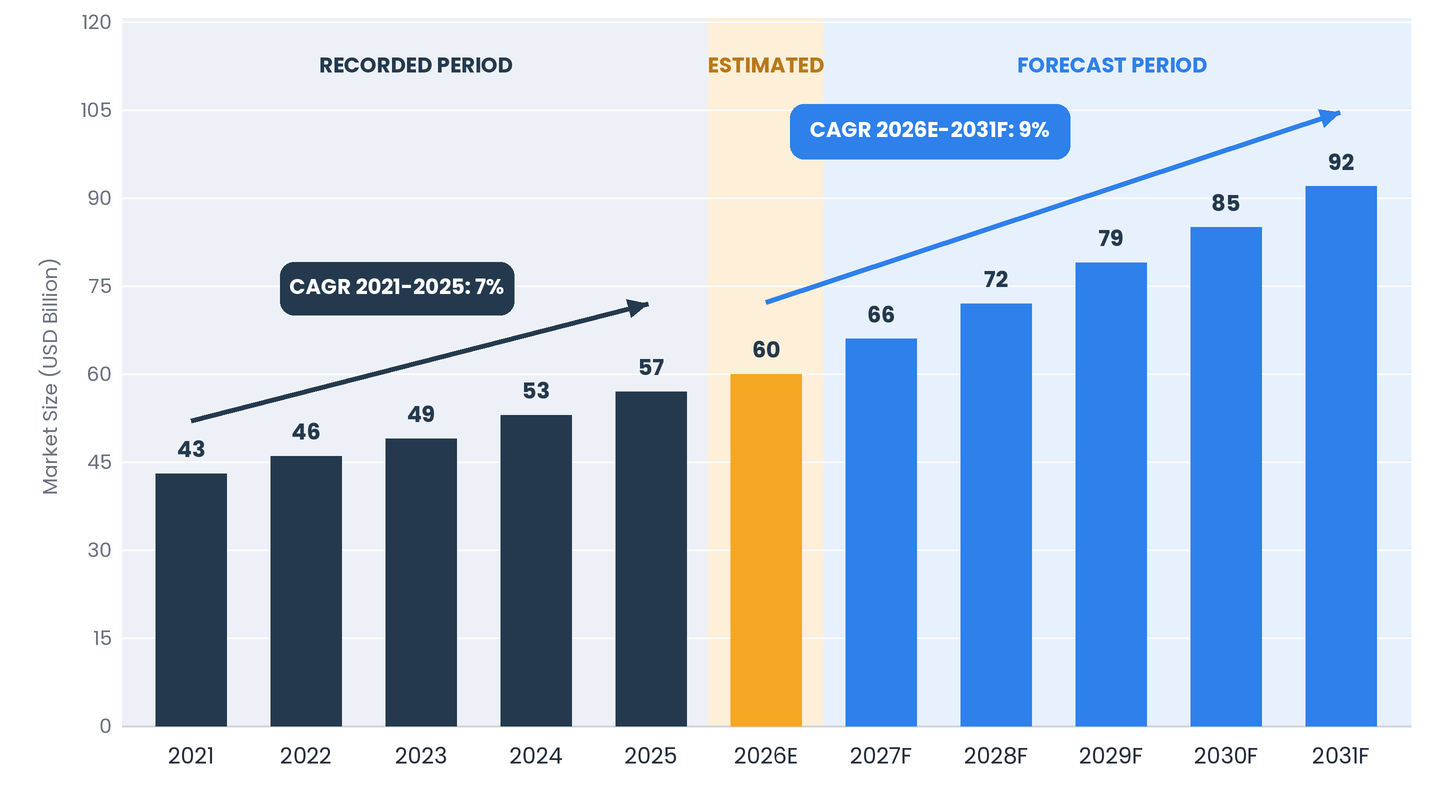
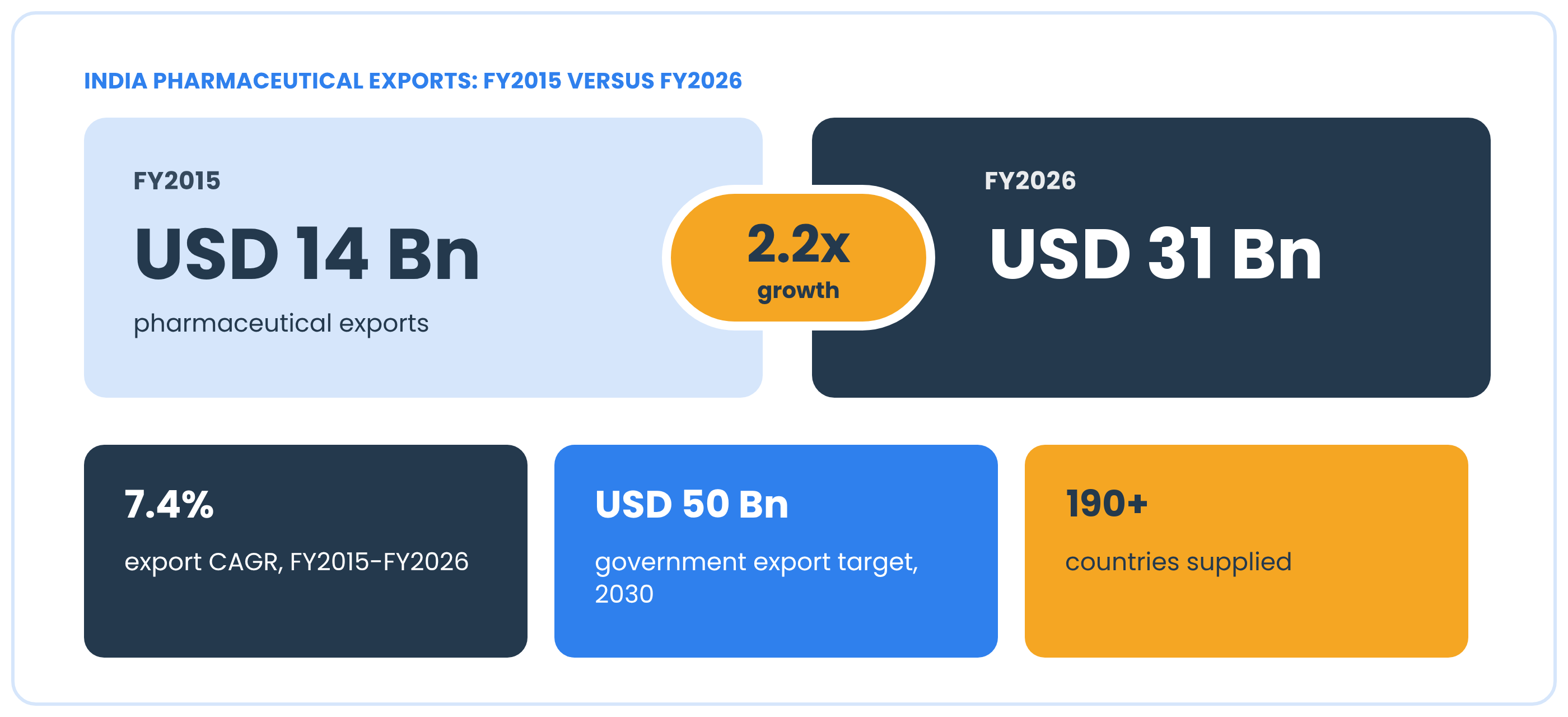
India is the world’s third-largest pharmaceutical producer by volume and supplies nearly 20% of global generic medicine demand. Neargoal Consulting estimates the market, covering domestic and export sales, at about USD 57 billion in 2025, rising to USD 60 billion in 2026E and USD 92 billion by 2031, a 9% CAGR over 2026E-2031F, after a 7% CAGR over 2021-2025. Exports reached about USD 31 billion in FY2026, up from about USD 14 billion in FY2015, and the Government of India has set an export target of USD 50 billion by 2030.
Key Takeaway Volume leadership is established, so the next gains come from value: biosimilars, specialty products, complex generics and higher-value exports. Producers that diversify markets and secure input supply will protect margins as pricing pressure persists. |
India Pharma Market at a Glance
MARKET DEFINITION Value of Pharmaceutical Formulations, Active Ingredients, Biosimilars and Vaccines Produced in India and Sold Domestically and Abroad (USD Billion) | ||
BASE YEAR / ESTIMATED YEAR 2025 / 2026E | FORECAST PERIOD 2027F-2031F | |
MARKET SIZE, 2025 USD 57 Billion | MARKET SIZE, 2026E USD 60 Billion | |
MARKET SIZE, 2031F USD 92 Billion | RECORDED CAGR, 2021-2025 7% | |
FORECAST CAGR, 2026E-2031F 9% | PHARMACEUTICAL EXPORTS, FY2026 About USD 31 Billion (INR 2.86 Trillion) | |
EXPORT GROWTH, FY2015-FY2026 7.4% CAGR (USD 14 Billion to USD 31 Billion) | EXPORT TARGET, 2030 USD 50 Billion | |
INDUSTRY SIZE TARGET, 2030 USD 130 Billion | SHARE OF EXPORTS TO HIGHLY REGULATED MARKETS Over 60% | |
LEADING PRODUCT TYPE Generic Formulations | KEY CONSTRAINTS Pricing Pressure, Regulation and Input Dependence | |
Source: Neargoal Consulting Analysis | ||
Market Outlook
Our study estimates the market will grow at a 9% forecast CAGR (2026E-2031F) from USD 60 billion in 2026E, after a 7% CAGR over 2021-2025. The base case assumes exports keep growing from USD 31 billion in FY2026 toward the government target of USD 50 billion by 2030, with domestic growth steady. Officials have said the industry could reach USD 130 billion by 2030, which our base case treats as an ambition rather than an expectation. Exports have grown at a 7.4% CAGR from FY2015 to FY2026.
Figure 1: India Pharma Market Size, 2021-2031F (USD Billion)
Source: Neargoal Consulting Analysis
Figure 2: India Pharmaceutical Exports, FY2015 Versus FY2026
Source: Neargoal Consulting Analysis
Market Dynamics
Growth Drivers
- Generic Scale and Quality Record. India exports to more than 190 countries, over 60% of exports go to highly regulated markets, and the country has about 1,000 US FDA-registered manufacturing facilities, the most outside the US.
- Shift from Volume to Value. Officials describe a move toward value-driven exports, with growth in biosimilars, vaccines and specialty drugs alongside generic formulations and bulk drugs.
- Government Programs. Biopharma SHAKTI, a proposed USD 1.15 billion (INR 100 billion) five-year program, aims to make India a biopharmaceutical manufacturing hub, and Global Capability Centres employ more than 100,000 professionals.
Restraints
- Pricing Pressure. Generic prices in the main export markets are under constant pressure, compressing margins.
- Regulatory Hurdles. Inspections and quality findings by regulators can delay approvals and shipments.
- Geopolitical Uncertainty and Input Dependence. Trade policy shifts and reliance on imported active ingredients and intermediates expose producers to disruption.
Opportunities
- Biosimilars and Specialty Products. Higher-value products raise export revenue per unit, and investment in biotechnology is rising.
- Market Diversification. The US, Europe, Africa and emerging economies all drive demand, and diversification reduces dependence on any one market.
- Active Ingredient Self-Reliance. Domestic active ingredient capacity reduces import dependence and supports resilience.
- Contract Development and Manufacturing. Global firms seeking supply chain resilience can use Indian contract manufacturers.
Policy and Regulatory Landscape
Pharmaceutical policy is led by the Department of Pharmaceuticals, the Ministry of Health and Family Welfare, the Central Drugs Standard Control Organisation and the Department of Commerce. The National Pharmaceutical Pricing Authority controls prices of scheduled medicines, and production-linked incentive schemes support active ingredients and key starting materials. Biopharma SHAKTI is a proposed USD 1.15 billion (INR 100 billion) five-year program for biopharmaceutical manufacturing. Export markets apply their own quality rules, including US FDA standards. The full report assesses how pricing, incentive and quality rules affect margins and investment.
Segment Insights
The full report quantifies every segment; the highlights below cover Product Type, Market, and Therapeutic Area.
By Product Type
Generic formulations account for the largest share of both domestic and export sales.
By Market
The domestic market is larger by volume and serves chronic and acute conditions through branded generics and trade generics. Exports reached about USD 31 billion in FY2026, led by the US, Europe, Africa and emerging economies, and are expected to grow faster than domestic sales as the government targets USD 50 billion by 2030. Our analysis expects exports to take a rising share of value.
By Therapeutic Area
- Chronic and Lifestyle. Cardiovascular, diabetes and central nervous system therapies, which grow with ageing and urbanization.
- Acute and Anti-Infective. Antibiotics and acute care products with large volumes and lower prices.
- Others. Oncology, respiratory, vaccines and specialty areas.
Geographic Insights
Production clusters in a few states supply both domestic distribution and exports.
- Gujarat. A major base for formulations and active ingredients, with large clusters around Ahmedabad and Vadodara.
- Maharashtra. Home to large company headquarters and manufacturing in Mumbai and Pune.
- Telangana. Hyderabad is a major hub for generics, active ingredients and contract development.
- Himachal Pradesh and Northern States. Large formulation clusters at Baddi and nearby sites.
Competitive Landscape
Key participants include Sun Pharmaceutical Industries, Dr. Reddy’s Laboratories, Cipla, Lupin, Aurobindo Pharma, Zydus Lifesciences, Torrent Pharmaceuticals, Biocon and Serum Institute of India. Competition rests on regulatory record, cost, portfolio breadth and access to regulated markets. Industry leaders are expanding into biosimilars, complex generics and specialty products to raise value per unit.
Sun Pharmaceutical Industries | Dr. Reddy’s Laboratories | Cipla | Lupin |
Aurobindo Pharma | Zydus Lifesciences | Torrent Pharmaceuticals | Biocon |
Serum Institute of India |
Key Developments, 2025-2026
- FY2026. Pharmaceutical exports surpass USD 31 billion (INR 2.86 trillion), despite global headwinds.
- June 2026. The Department of Commerce says exports have doubled in 12 years and sets a goal of USD 50 billion by 2030.
- Policy. Biopharma SHAKTI is proposed as a USD 1.15 billion (INR 100 billion) five-year program for biopharmaceutical manufacturing.
- Capabilities. Global Capability Centres in the sector employ more than 100,000 professionals and have attracted over USD 1 billion.
What This Means for Decision-Makers
- Manufacturers: Diversify export markets and move the product mix toward biosimilars and specialty drugs.
- Active Ingredient Producers: Use incentive schemes to build capacity that reduces import dependence.
- Investors: Underwrite on regulatory record and pricing resilience, not only on volume.
- Policymakers: Keep quality standards and incentives aligned with export goals.
About the Report
Table 1: India Pharma Market: Report Coverage
Coverage Area | What the Report Covers |
Market Size and Forecast | Revenue (USD Billion) and Export Views, 2021-2031F |
Segmentation | Product Type, Market, Therapeutic Area and State |
Geography | Gujarat, Maharashtra, Telangana, Himachal Pradesh and Other States |
Competition | Manufacturers, Contract Developers, Exporters and Pipeline Tracking |
Policy and Constraints | Pricing Rules, Incentive Schemes, Quality Standards and Trade |
Outlook and Recommendations | White-Space Assessment and Guidance by Stakeholder |
Source: Neargoal Consulting Analysis | |
The research report, India Pharma Market Outlook 2021-2031F - Market Size, Share, Trends, Opportunities, and Competitive Analysis - Segmented by Product Type (Generic Formulations, Active Pharmaceutical Ingredients, and Biosimilars, Vaccines and Specialty); Market (Domestic, and Export); Therapeutic Area (Chronic and Lifestyle, Acute and Anti-Infective, and Others); and Region, covers pharmaceutical formulations, active ingredients, biosimilars and vaccines produced in India and sold domestically and abroad, with a 2025 base year, a 2026E estimate and a 2027F-2031F forecast. It excludes medical devices, diagnostics, nutraceuticals and contract research services. Market estimates and projections are based on Neargoal Consulting’s proprietary research methodology, exhaustive primary and secondary research.
For questions about report coverage, methodology, suitability, etc.
For requirements beyond the published report