UAE Green Hydrogen Market Outlook 2021-2031F
Market Size, Share, Trends, Opportunities, and Competitive Analysis - Segmented by Electrolyzer Technology (Alkaline, Proton Exchange Membrane, and Others); Application (Green Ammonia and Export, Steel and Industry, and Mobility and Power); Project Scale (Pilot and Demonstration, and Commercial Scale); and Region
UAE Green Hydrogen Market to Reach USD 220 Million by 2031, Growing at a 65% CAGR: How National Targets, Abu Dhabi Pilots and Export Ambitions Are Moving Hydrogen from Demonstration Toward Commercial Scale

UAE Green Hydrogen Market Overview
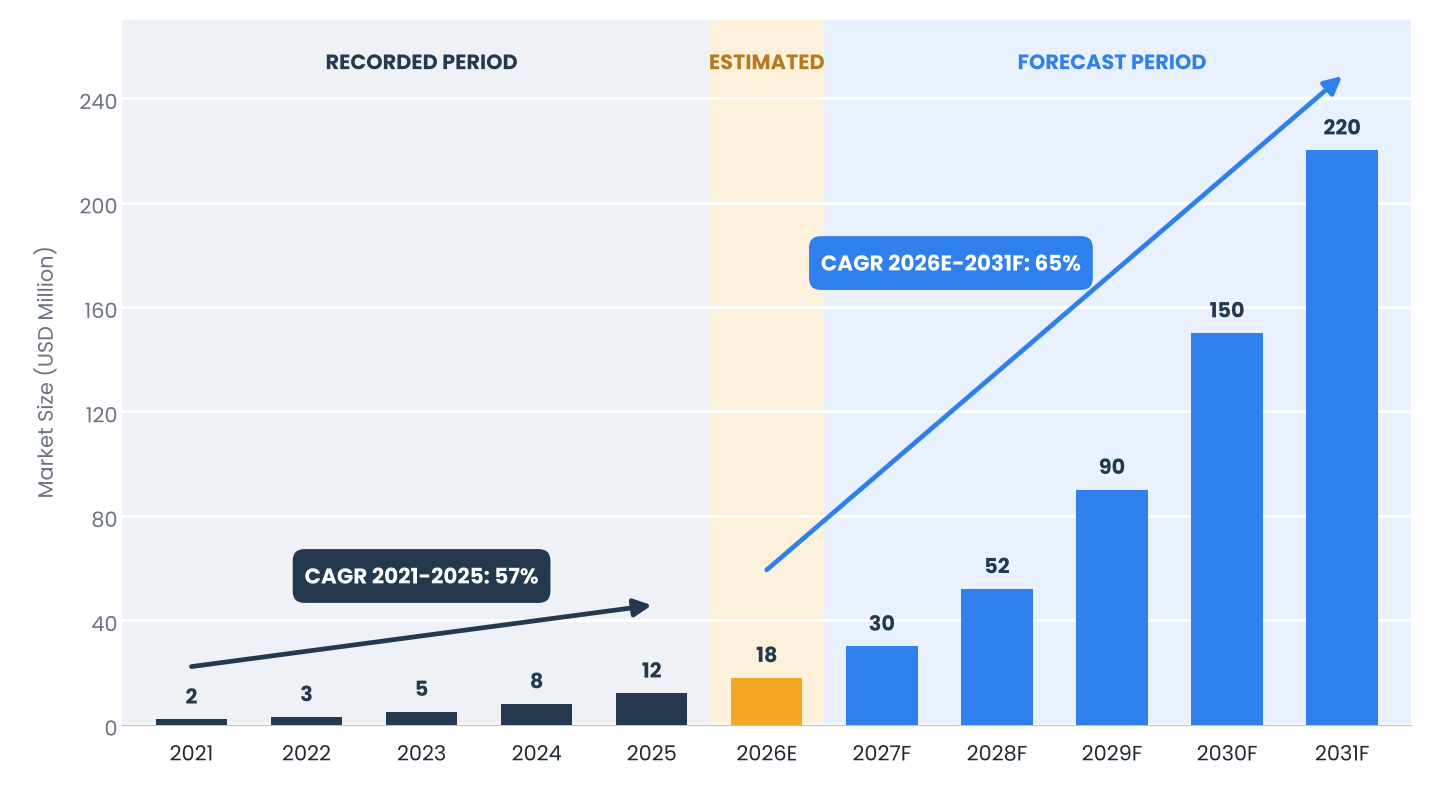
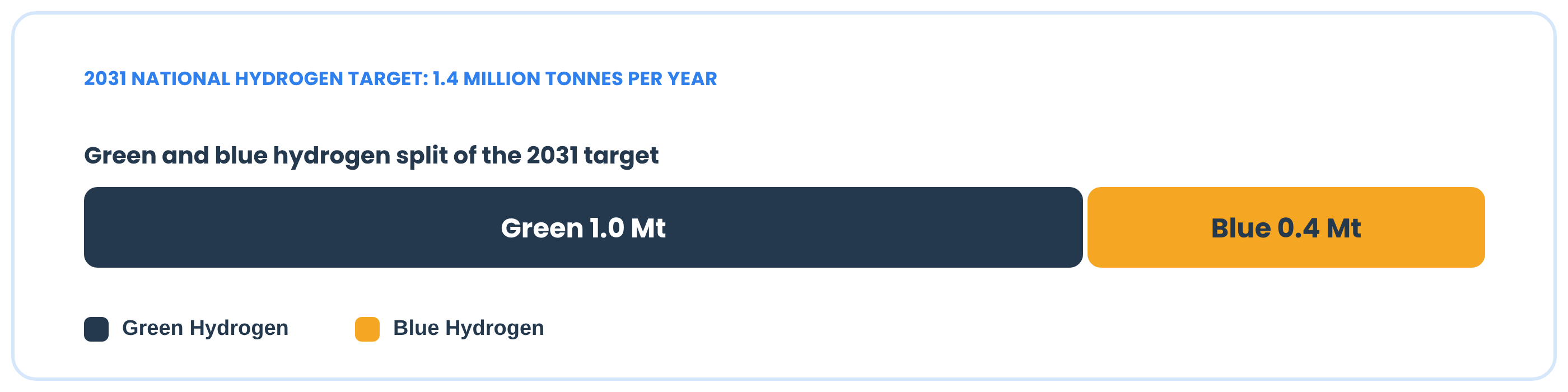
The UAE has set out to become a low-emission hydrogen producer and supplier, backed by abundant solar resources and state-owned energy groups. Neargoal Consulting estimates the green hydrogen market at about USD 12 million in 2025, rising to USD 18 million in 2026E and USD 220 million by 2031, a 65% CAGR over 2026E-2031F, after a 57% CAGR over 2021-2025 from a very small base. The National Hydrogen Strategy sets production targets of 1.4 million tonnes per year by 2031, including 1.0 million tonnes of green hydrogen, but demand, offtake contracts and infrastructure will decide how much of it is built.
Key Takeaway Targets are ambitions, not volumes. Revenue in the early years comes from pilots, industrial decarbonization trials and technology supply, while commercial scale depends on offtake contracts, a narrowing cost gap with fossil-based hydrogen and export infrastructure. |
Table 1: UAE Green Hydrogen Market: Key Insights
Metric | Finding |
Market Definition | Value of Green Hydrogen and Derivatives Produced by Electrolysis and Sold in the UAE (USD Million) |
Base Year / Estimated Year | 2025 / 2026E |
Forecast Period | 2027F-2031F |
Market Size, 2025 | USD 12 Million |
Market Size, 2026E | USD 18 Million |
Market Size, 2031F | USD 220 Million |
Recorded CAGR, 2021-2025 | 57% |
Forecast CAGR, 2026E-2031F | 65% |
National Hydrogen Production Target, 2031 | 1.4 Million Tonnes per Year (1.0 Green, 0.4 Blue) |
National Hydrogen Production Target, 2050 | 15 Million Tonnes per Year |
Electrolyzer Capacity Needed | 8.7 GW |
Solar Capacity Needed | 15.3 GW |
Renewable Energy Allocation to 2050 | AED 600 Billion |
Leading Application | Industrial Pilots, Green Steel and Ammonia |
Key Constraints | Cost Premium, Offtake and Infrastructure |
Source: Neargoal Consulting Analysis | |
Market Outlook
Our study estimates the market will grow at a 65% forecast CAGR (2026E-2031F) from USD 18 million in 2026E, after a 57% CAGR over 2021-2025 from a very small base. The base case assumes pilot-scale projects in 2026E-2028F, followed by first commercial-scale electrolyzer capacity from 2029F as offtake agreements are signed. Masdar, Abu Dhabi’s main renewables company, has pushed its target of 1 million tonnes per year of green hydrogen capacity beyond 2030, to within the next decade, which our base case reflects by assuming that national targets are met later than planned.
Figure 1: UAE Green Hydrogen Market Size, 2021-2031F (USD Million)
Source: Neargoal Consulting Analysis
Figure 2: UAE 2031 Hydrogen Target by Type
Source: Neargoal Consulting Analysis
Market Dynamics
Growth Drivers
- National Strategy and Funding. The National Hydrogen Strategy 2050 targets 1.4 million tonnes per year by 2031, 7.5 million by 2040 and 15 million by 2050, and AED 600 billion has been allocated to renewable energy through 2050, including hydrogen.
- Low-Cost Solar and State-Owned Developers. The strategy requires about 15.3 GW of solar capacity and 8.7 GW of electrolyzers, and Masdar, ADNOC and TAQA bring capital, project experience and access to export infrastructure.
- Industrial Decarbonization. Emsteel and Masdar completed a pilot in Abu Dhabi that uses green hydrogen to make steel from iron ore, described as the first in the Middle East and North Africa, showing a route to domestic demand.
Restraints
- Cost Premium. Emsteel’s chief executive has said that green hydrogen is more expensive than the alternative, and buyers must pay a premium and build infrastructure to receive and use the fuel.
- Offtake and Demand. Limited demand and the absence of binding long-term contracts have slowed the global sector, and the UAE is no exception.
- Project Delays. Masdar’s move of its capacity target beyond 2030 shows that timelines are slipping, and few large green hydrogen projects worldwide have reached construction.
Opportunities
- Green Steel and Industry. Domestic steel, aluminum and chemicals producers can use hydrogen to reduce emissions, creating the first local offtake base.
- Green Ammonia for Export. Ammonia is easier to ship than hydrogen, and the strategy positions the UAE as a hydrogen hub supplying European and Asian markets.
- Electrolyzer and Equipment Supply. Pilot projects and regional manufacturing plans open work for electrolyzer, storage and compression suppliers.
- Partnerships Across the Value Chain. Masdar has framework or exploratory agreements with Equinor, Aker Horizons and Yara covering supply chains, power-to-hydrogen development and green ammonia.
Policy and Regulatory Landscape
The Ministry of Energy and Infrastructure leads national hydrogen policy. The National Hydrogen Strategy 2050 aims to make the UAE a low-emission hydrogen producer and supplier by 2031, with four focus areas: growing the domestic market, building a regulatory framework, deepening regional collaboration and increasing research investment to lower costs. Planned measures include hydrogen oases, supply chain development and a national research center, and public-private partnerships with ADNOC, Masdar and TAQA cover production, storage and export. The full report assesses how incentives, certification and offtake rules will affect project timing.
Segment Insights
By Electrolyzer Technology, alkaline systems lead on cost and maturity, while proton exchange membrane systems suit variable solar supply. The full report quantifies every segment; the highlights below cover Application and Project Scale.
By Application
Industrial pilots, green steel and ammonia account for most activity in 2025, led by the Emsteel and Masdar steel pilot in Abu Dhabi. Export-oriented ammonia is expected to become the largest application by 2031F if offtake agreements with European and Asian buyers are signed, while mobility and power remain smaller. Our analysis expects domestic industry to anchor early demand.
By Project Scale
- Pilot and Demonstration. Projects such as the Abu Dhabi green steel pilot and earlier solar-powered electrolysis demonstrations, which generate most revenue in 2025.
- Commercial Scale. The growth segment, dependent on offtake contracts, financing and export infrastructure.
Geographic Insights
Activity is concentrated in Abu Dhabi, where state-owned developers, industrial zones and ports are located.
- Abu Dhabi. Hosts Masdar, ADNOC, TAQA and Emsteel, and the green steel pilot that uses solar power from the emirate’s grid.
- Dubai. Dubai Electricity and Water Authority runs a solar-powered hydrogen demonstration at the Mohammed bin Rashid Al Maktoum Solar Park.
- Sharjah and Northern Emirates. Early-stage interest tied to industrial and port users, with smaller project sizes.
Competitive Landscape
Key participants include Masdar, ADNOC, TAQA, Emsteel, Dubai Electricity and Water Authority, Siemens Energy, Equinor, Yara, Aker Horizons and AD Ports Group. Competition is shaped by access to low-cost solar, state backing and international partners. Masdar’s agreements with Equinor, Aker Horizons and Yara link UAE supply to European demand and green ammonia markets.
Masdar | ADNOC | TAQA | Emsteel |
Dubai Electricity and Water Authority | Siemens Energy | Equinor | Yara |
Aker Horizons | AD Ports Group |
Key Developments, 2025-2026
- Strategy. The National Hydrogen Strategy 2050 sets targets of 1.4 million tonnes per year by 2031, 7.5 million by 2040 and 15 million by 2050.
- Pilot. Emsteel and Masdar complete a pilot in Abu Dhabi that uses green hydrogen to extract iron from iron ore, the first of its kind in the Middle East and North Africa.
- Targets. Masdar moves its green hydrogen capacity target of 1 million tonnes per year beyond 2030, to within the next decade.
- Partnerships. Masdar signs or explores agreements with Equinor, Aker Horizons and Yara on supply chains, power-to-hydrogen development and green ammonia.
What This Means for Decision-Makers
- Developers: Secure offtake before committing capital, and stage investment behind confirmed demand.
- Industrial Users: Pilot hydrogen use in steel and chemicals to build experience before premiums fall.
- Equipment Suppliers: Position for regional manufacturing and pilot-to-commercial scale-up.
- Policymakers: Link incentives to offtake, certification and infrastructure milestones.
About the Report
Table 2: UAE Green Hydrogen Market: Report Coverage
Coverage Area | What the Report Covers |
Market Size and Forecast | Revenue (USD Million) and Capacity (MW) Views, 2021-2031F |
Segmentation | Electrolyzer Technology, Application, Project Scale and Emirate |
Geography | Abu Dhabi, Dubai, Sharjah and Northern Emirates |
Competition | Developers, Industrial Users, Equipment Suppliers and Partnership Tracking |
Policy and Constraints | National Hydrogen Strategy, Incentives, Offtake and Infrastructure |
Outlook and Recommendations | White-Space Assessment and Guidance by Stakeholder |
Source: Neargoal Consulting Analysis | |
The research report, UAE Green Hydrogen Market Outlook 2021-2031F - Market Size, Share, Trends, Opportunities, and Competitive Analysis - Segmented by Electrolyzer Technology (Alkaline, Proton Exchange Membrane, and Others); Application (Green Ammonia and Export, Steel and Industry, and Mobility and Power); Project Scale (Pilot and Demonstration, and Commercial Scale); and Region, covers green hydrogen and derivatives produced by electrolysis and sold in the UAE, with a 2025 base year, a 2026E estimate and a 2027F-2031F forecast. It excludes blue hydrogen, grey hydrogen and hydrogen produced for export markets outside the country’s sales. Market estimates and projections are based on Neargoal Consulting’s proprietary research methodology, exhaustive primary and secondary research.
For questions about report coverage, methodology, suitability, etc.
For requirements beyond the published report