India Grid-Scale BESS Market Outlook 2021-2031F
Market Size, Share, Trends, Opportunities, and Competitive Analysis - Segmented by Application (Standalone, Solar-Plus-Storage, and Hybrid); Duration (Two-Hour, Four-Hour, and Longer-Duration); Technology (Lithium Iron Phosphate, Other Lithium-Ion, and Emerging Chemistries); and Region
India Grid-Scale BESS Capacity to Reach 140 GWh by 2031, Growing at a 59% CAGR: How Standalone Storage, Fast Tenders and a Large Pipeline Are Reshaping the Power Grid

India Grid-Scale BESS Market Overview
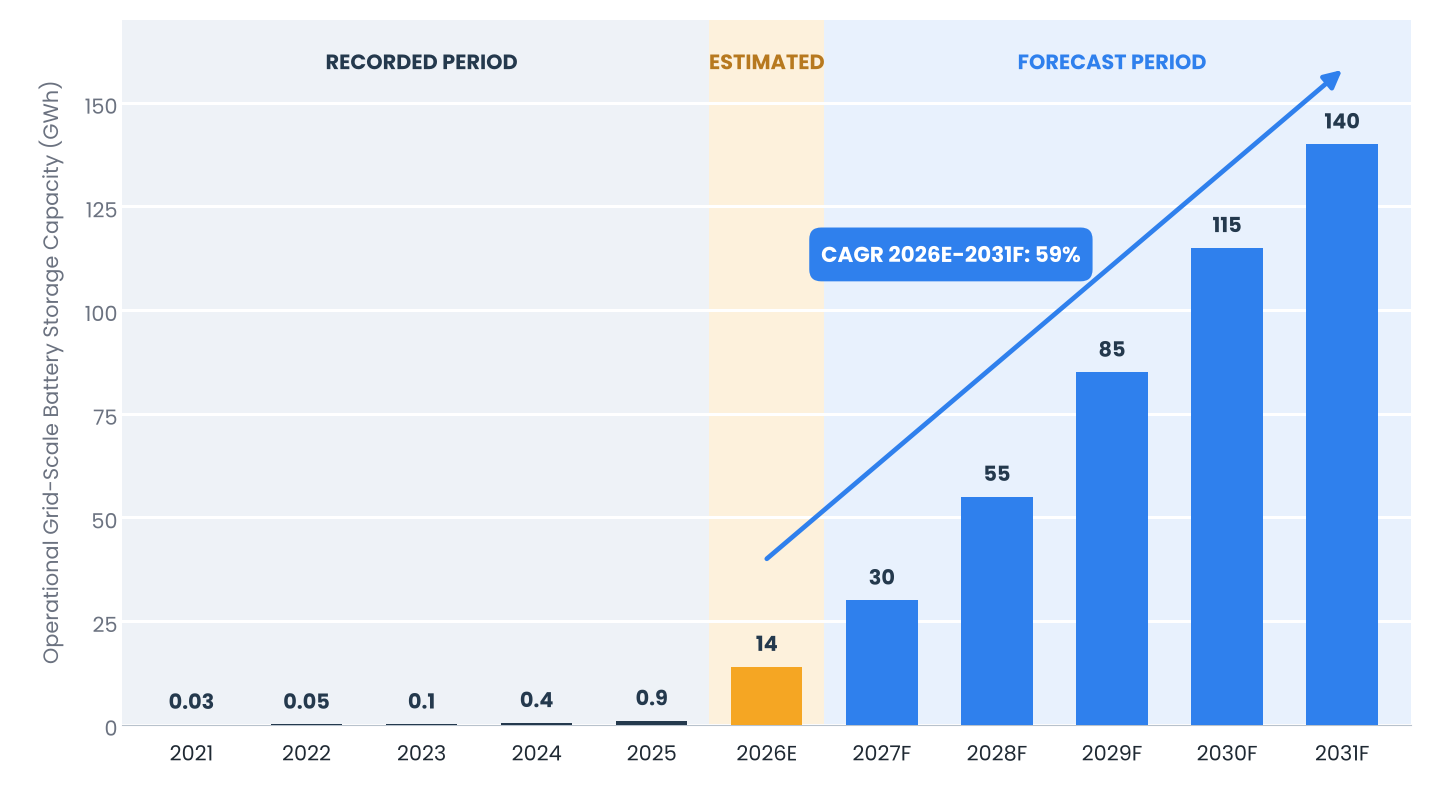
India’s grid-scale battery storage market is moving from pilot projects to utility-scale delivery. Neargoal Consulting estimates operational capacity at about 0.9 GWh in 2025, rising to 14 GWh in 2026E and 140 GWh by 2031, a 59% CAGR over 2026E-2031F, as grid operators add storage to absorb solar and wind output and cover evening peaks. Operational capacity reached 9.08 GWh by August 2026, with a further 79.92 GWh under construction and 63.53 GWh in tendering. Standalone, merchant-backed projects drive most additions, while tariffs and delivery risk will decide how much of the pipeline is built. The research report quantifies the market by Application, Duration, Technology and Region and shows where the next wave of capacity will land.
Key Takeaway India’s storage fleet is set to grow about ten-fold over 2026E-2031F, but built capacity will track tariffs, cell supply and grid connections more than tender volumes. Developers that lock in cells, sites and offtake early will convert the pipeline into revenue. |
India Grid-Scale BESS Market at a Glance
MARKET DEFINITION Operational Grid-Scale Battery Storage Capacity (GWh) Connected to India’s Power Grid | ||
BASE YEAR / ESTIMATED YEAR 2025 / 2026E | FORECAST PERIOD 2027F-2031F | |
MARKET SIZE, 2025 0.9 GWh | MARKET SIZE, 2026E 14 GWh | |
MARKET SIZE, 2031F 140 GWh | FORECAST CAGR, 2026E-2031F 59% | |
OPERATIONAL CAPACITY, AUGUST 2026 9.08 GWh | PIPELINE, ALL STAGES 176.66 GWh, Including 79.92 GWh Under Construction | |
GOVERNMENT REQUIREMENT, FY2031-32 236 GWh (National Electricity Plan) | LEADING APPLICATION, NEW ADDITIONS Standalone Storage | |
DOMINANT DURATION Two-Hour Systems | LEADING STATES Gujarat and Rajasthan | |
DOMINANT TECHNOLOGY Lithium-Ion, Led by Lithium Iron Phosphate | KEY CONSTRAINTS Tariff Viability, Cell Supply and Grid Connectivity | |
Source: Neargoal Consulting Analysis | ||
Market Outlook
Our study estimates India’s operational grid-scale storage capacity will rise at a 59% forecast CAGR (2026E-2031F) from a small 2025 base, as awarded and under-construction projects reach commissioning. The identified pipeline across construction, award and tender stages totals 176.66 GWh, equal to about three-quarters of the 236 GWh that the National Electricity Plan projects for FY2031-32. Our analysis expects built capacity to trail the pipeline because of financing, equipment supply and grid connection delays, with annual additions peaking at about 30 GWh around 2029F-2030F.
Figure 1: India Grid-Scale BESS Market Size, 2021-2031F (GWh)
Source: Neargoal Consulting Analysis
Market Dynamics
Growth Drivers
- Renewable Integration and Peak Demand. Solar and wind additions are widening the gap between generation and demand. The Central Electricity Authority’s National Electricity Plan identifies a requirement of 236 GWh of battery storage by FY2031-32 to balance evening peaks.
- Government Funding and Waivers. Viability gap funding of USD 620 million (INR 54 billion) supports 30 GWh of projects, and inter-state transmission charges are waived for co-located storage commissioned before June 2028.
- Falling Costs and Tender Momentum. Standalone projects of 10.4 GW were allocated in 2025, and the lowest tariff for a two-hour system fell to USD 1,698 (INR 148,000) per MW per month, widening access for distribution companies.
Restraints
- Tariff Viability. Nearly three-quarters of allocated two-hour capacity is classed as at risk because discovered tariffs sit well below project costs.
- Cell Supply and Imports. India has about 2 GWh of lithium-ion cell capacity against announced plans of about 110 GWh by 2030, and lithium-ion battery imports rose to USD 4.7 billion in FY2026, with China supplying about 84%.
- Delivery Delays. Financial closure, procurement and commissioning can delay projects by up to 18 months, and grid connectivity remains uneven across states.
Opportunities
- Four-Hour and Longer Duration. Four-hour systems have gained prominence in tenders since mid-2025, opening a higher-value segment as evening peaks lengthen.
- Merchant and Hybrid Models. About 70% of capacity added in the first half of 2026 was merchant-backed, signalling room to stack energy and ancillary revenues.
- Domestic Cell Manufacturing. Under the production-linked incentive scheme for advanced chemistry cells, 40 GWh of the 50 GWh target has been awarded, creating room for local supply chains.
- Storage-Linked Renewable Tenders. Renewable energy agencies have been advised to shift to storage-linked, peak-power and firm and dispatchable renewable tenders, which pulls storage into every large bid.
Policy and Regulatory Landscape
The Central Electricity Authority’s planning documents set the direction: 41.65 GW of battery storage by 2029-30 and 47.24 GW by FY2031-32. Viability gap funding has been approved in two rounds, USD 431 million (INR 37.6 billion) for 13.22 GWh in March 2024 and USD 620 million (INR 54 billion) for 30 GWh in June 2025, and the Ministry of New and Renewable Energy has notified guidelines for procuring and using storage across generation, transmission and distribution. Inter-state transmission charges are waived for co-located storage commissioned by June 2028.
Segment Insights
By Application, standalone storage leads capacity additions, after solar-plus-storage dominated the earlier installed base, helped by state-led auctions and merchant revenue. Solar-plus-storage and hybrid projects remain important where co-location earns transmission waivers. The full report quantifies every segment; the highlights below cover Duration and Technology segments.
By Duration
Two-hour systems dominate awarded capacity, as most 2025 auctions specified two hours and two cycles a day, which suits evening peak shifting. Four-hour systems have gained prominence in tenders since mid-2025 as distribution companies seek longer evening support and developers seek higher utilization. Longer-duration chemistries remain at pilot scale. Our analysis expects four-hour capacity to take a rising share of 2028F-2031F additions.
By Technology
- Lithium Iron Phosphate. The preferred chemistry for utility-scale systems on cost, cycle life and safety, with most cells imported.
- Other Lithium-Ion. Nickel-based chemistries serve space-constrained and high-power sites but are less common in grid tenders.
- Emerging Chemistries. Sodium-ion and flow batteries are at demonstration stage and could widen supply options while cell imports remain concentrated.
Geographic Insights
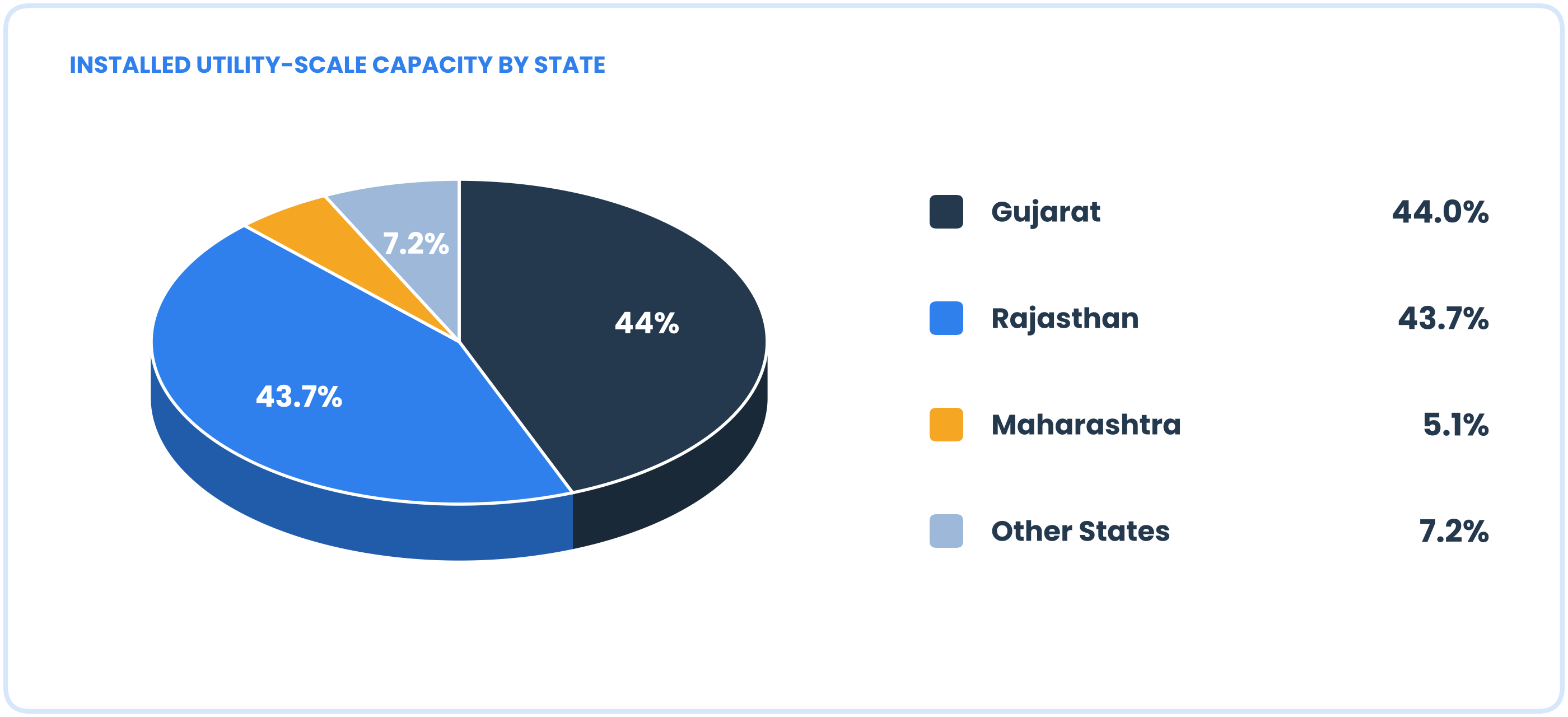
Gujarat and Rajasthan hold nearly 88% of installed utility-scale capacity, with Gujarat at 44.0%, Rajasthan at 43.7% and Maharashtra at 5.1%, reflecting their large solar parks and transmission build-out. State auctions are broadening the geography.
Figure 2: India Grid-Scale BESS Installed Capacity by State
Source: Neargoal Consulting Analysis
- Gujarat. Adani Green Energy has commissioned 3.37 GWh at Khavda, and the state holds the largest standalone project pipeline.
- Rajasthan. A 1 GW/2 GWh state tender set a benchmark below USD 2,000 per MW per month in 2025.
- Maharashtra, Karnataka, Tamil Nadu and Telangana. Maharashtra is the third-largest installed base, while Karnataka, Tamil Nadu and Telangana have held standalone auctions that are widening the footprint.
Competitive Landscape
Key participants include developers, utilities and cell makers such as Adani Green Energy, Tata Power, JSW Energy, NTPC, ReNew, Avaada, IndiGrid, ACME Solar, Greenko, Amara Raja, Exide Industries and Waaree Energies. Competition is shifting from tender wins to securing cells, sites and offtake. Adani Green Energy plans more than 10 GWh of additions in FY2026-27 and 50 GWh over five years, setting the pace for the field.
Adani Green Energy | Tata Power | JSW Energy | NTPC |
ReNew | Avaada | IndiGrid | ACME Solar |
Greenko | Amara Raja | Exide Industries | Waaree Energies |
Logos are trademarks of their respective owners, shown for identification only; no affiliation or endorsement is implied.
Key Developments, 2025-2026
- June 2025. The Ministry of Power approves viability gap funding of USD 620 million (INR 54 billion) to support 30 GWh of battery storage across 15 states and NTPC.
- November 2025. Adani Group announces a 1,126 MW/3,530 MWh battery project at Khavda, described as India’s largest to date.
- March 2026. Adani Green Energy adds 1.37 GWh at Khavda, taking the site to 3.37 GWh within 10 months of construction start.
- August 2026. Operational capacity reaches 9.08 GWh, after 8.2 GWh was added in the first half of 2026 against under 100 MWh a year earlier.
What This Means for Decision-Makers
- Developers: Lock in cells, connectivity and offtake before bidding; low tariffs leave little margin for delay.
- Distribution Companies: Specify duration and performance guarantees to protect asset quality.
- Investors: Underwrite on tariffs, delivery record and counterparty strength, not on tender volumes.
- Cell and Equipment Suppliers: Localization and four-hour products are the next addressable demand.
About the Report
Table 1: India Grid-Scale BESS Market: Report Coverage
Coverage Area | What the Report Covers |
Market Size and Forecast | Energy Capacity (GWh) and Investment (USD) Views, 2021-2031F |
Segmentation | Application, Duration, Technology and Region |
Geography | Gujarat, Rajasthan, Maharashtra, Karnataka, Tamil Nadu, Telangana and Other States |
Competition | Developers, Utilities, Cell Makers, Tender Awards and Pipeline Tracking |
Policy and Constraints | Viability Gap Funding, Transmission Waivers, Tariffs, Cell Supply and Delivery Risk |
Outlook and Recommendations | White-Space Assessment and Guidance by Stakeholder |
Source: Neargoal Consulting Analysis | |
The research report, India Grid-Scale BESS Market Outlook 2021-2031F - Market Size, Share, Trends, Opportunities, and Competitive Analysis - Segmented by Application (Standalone, Solar-Plus-Storage, and Hybrid); Duration (Two-Hour, Four-Hour, and Longer-Duration); Technology (Lithium Iron Phosphate, Other Lithium-Ion, and Emerging Chemistries); and Region, covers utility-scale, grid-connected battery energy storage systems in India, with a 2025 base year, a 2026E estimate and a 2027F-2031F forecast. It excludes behind-the-meter commercial and residential systems, pumped hydro storage and electric vehicle batteries. Market estimates and projections are based on Neargoal Consulting’s proprietary research methodology, exhaustive primary and secondary research.
For questions about report coverage, methodology, suitability, etc.
For requirements beyond the published report