
US AI Inference Chip Market Outlook 2021-2031F
Market Size, Share, Trends, Opportunities, and Competitive Analysis - Segmented by Chip Type (GPUs, Custom ASICs, and CPUs, FPGAs and Others); Deployment (Cloud Data Center, Enterprise and On-Premises, and Edge); End User (Cloud Service Providers, Enterprises, and Government and Others); and Region
US AI Inference Chip Market to Reach USD 34.5 Billion by 2031, Growing at a 25% CAGR: How Hyperscaler Spending, Custom Silicon and the Shift from Training to Production Are Reshaping Demand

US AI Inference Chip Market Overview
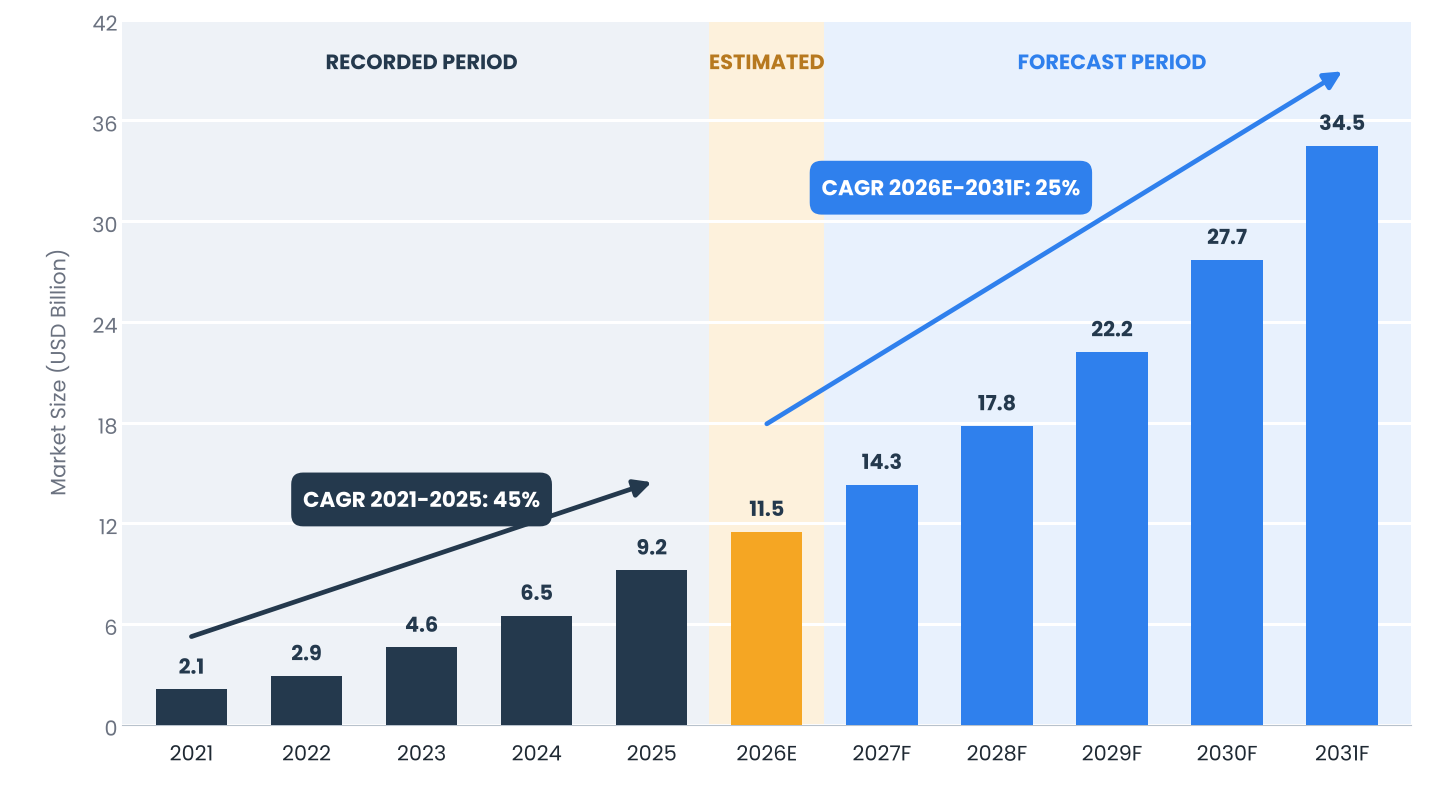
AI inference, the stage where trained models answer real requests, is becoming the largest recurring source of demand for AI chips. Neargoal Consulting estimates the US AI inference chip market at about USD 9.2 billion in 2025, rising to USD 11.5 billion in 2026E and USD 34.5 billion by 2031, a 25% CAGR over 2026E-2031F, after a 45% CAGR over 2021-2025. The four largest cloud buyers have guided to capital spending of roughly USD 115 billion to USD 200 billion each for 2026, and the market is broadening from graphics processors toward custom accelerators, central processors and edge devices as inference moves into every software product.
Key Takeaway Inference demand rewards cost per token and power efficiency more than peak speed, which favors buyers that can design or specify their own silicon. Suppliers that pair chips with software, memory supply and power-ready sites will hold the strongest position as spending shifts from training to production. |
US AI Inference Chip Market at a Glance
MARKET DEFINITION Value of Processors and Accelerators Purchased in the US to Run Trained AI Models in Production (USD Billion) | ||
BASE YEAR / ESTIMATED YEAR 2025 / 2026E | FORECAST PERIOD 2027F-2031F | |
MARKET SIZE, 2025 USD 9.2 Billion | MARKET SIZE, 2026E USD 11.5 Billion | |
MARKET SIZE, 2031F USD 34.5 Billion | RECORDED CAGR, 2021-2025 45% | |
FORECAST CAGR, 2026E-2031F 25% | HYPERSCALER CAPITAL SPENDING GUIDANCE, 2026 USD 115-200 Billion Each Across Four Largest Buyers | |
LARGEST INFERENCE CHIP DEAL Nvidia and Groq, USD 20 Billion, December 2025 | SHARE OF COMPUTE SPENDING HELD BY GPUS, 2025 58% | |
LEADING CHIP TYPE GPUs | FASTEST-GROWING CHIP TYPE Custom ASICs | |
KEY CONSTRAINTS Power, Advanced Packaging and Memory Supply | ||
Source: Neargoal Consulting Analysis | ||
Market Outlook
Our study estimates the market will grow at a 25% forecast CAGR (2026E-2031F) from USD 11.5 billion in 2026E, after a 45% CAGR over 2021-2025 from a small base. The base case assumes continued data center build-out through 2028F, with growth moderating as custom accelerators gain share and unit prices fall. A broader view that adds memory and networking hardware puts US inference hardware spending at about USD 32 billion in 2025, which shows how much of the value chain sits beside the processor itself. An industry survey put GPUs at 58% of data center compute spending in 2025 and expects chips that are neither GPUs nor CPUs to lead 2026 growth at 22%, ahead of GPUs at 19% and CPUs at 14%.
Figure 1: US AI Inference Chip Market Size, 2021-2031F (USD Billion)
Source: Neargoal Consulting Analysis
Market Dynamics
Growth Drivers
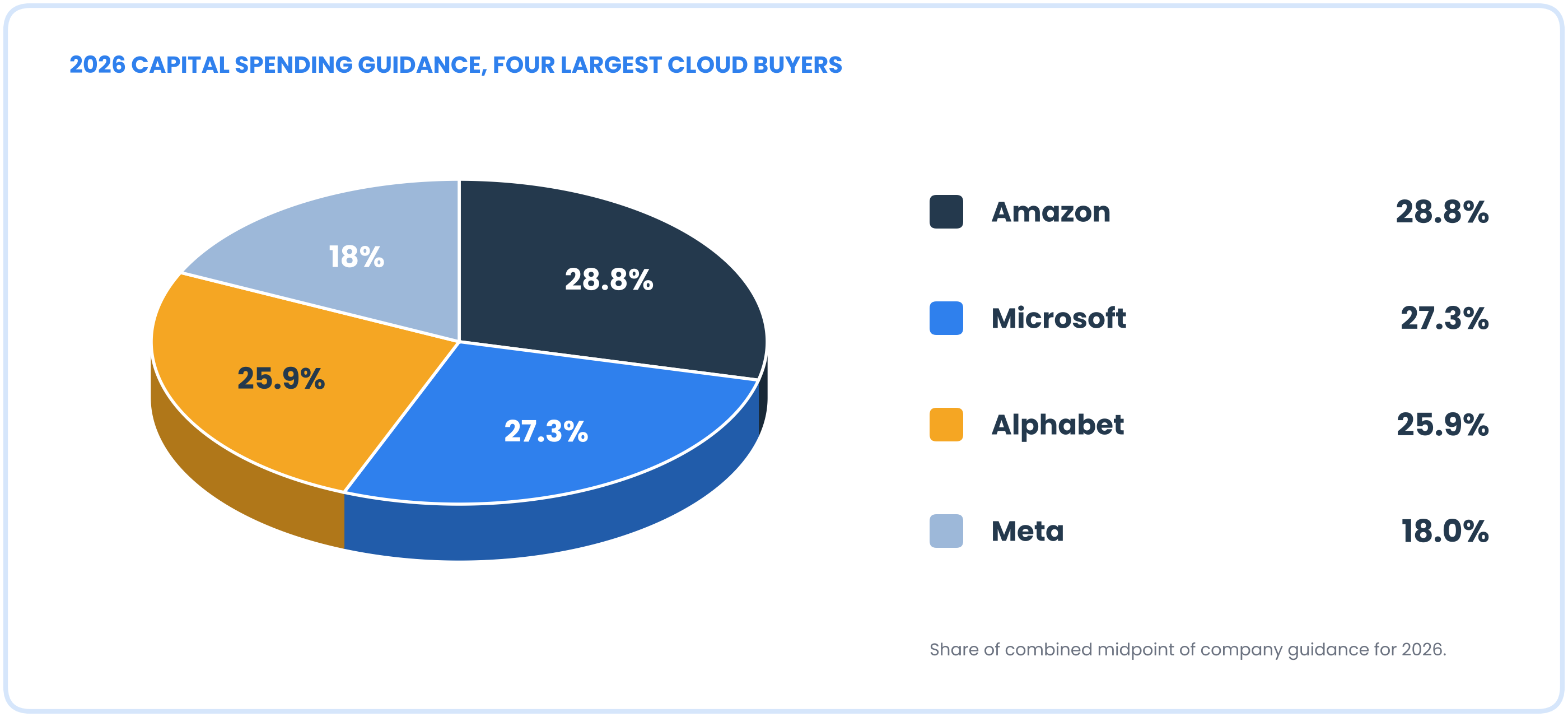
- Hyperscaler Capital Spending. Amazon, Microsoft, Alphabet and Meta guided to roughly USD 200 billion, USD 190 billion, USD 175-185 billion and USD 115-135 billion respectively for 2026, with a growing share aimed at serving models rather than training them.
- Shift from Training to Production. Nvidia executives said in 2024 that about 40% of its data center revenue came from inference, and Cerebras reports that about 70% of its workloads are inference, showing how quickly production use is overtaking experimentation.
- Custom Silicon Adoption. Amazon Web Services reports that more than half of the tokens on its Bedrock inference service run on its own Trainium chips, and Google, Microsoft and Meta are deploying their own accelerators.
Restraints
- Power and Site Readiness. Data center capacity, grid connections and cooling limit how fast new accelerators can be installed, regardless of chip supply.
- Memory and Packaging Supply. High-bandwidth memory and advanced packaging capacity remain tight and concentrate supply risk in a few producers.
- Export Controls and Trade Policy. Rules on advanced chip exports and semiconductor tariffs add uncertainty to supply chains and pricing.
Opportunities
- Custom Accelerators for Large Buyers. Cloud providers and large model developers are commissioning inference-specific designs, opening work for design partners, packaging houses and software toolchain vendors.
- Low-Latency and Long-Context Inference. Products such as Nvidia’s Rubin CPX, announced in September 2025 for massive-context inference, and Groq’s low-latency processors show demand for specialized parts.
- Enterprise and On-Premises Deployment. Regulated industries that keep data in-house are buying accelerators and inference servers directly, creating a market beyond the cloud providers.
- Edge and Embedded Inference. Vehicles, factories and devices that cannot rely on connectivity need efficient inference silicon, an area where Qualcomm, Arm-based and RISC-V designers are active.
Policy and Regulatory Landscape
US policy shapes both supply and demand. The CHIPS and Science Act funds domestic semiconductor manufacturing, America’s AI Action Plan of July 2025 sets national priorities for data center build-out and chip exports, and the Bureau of Industry and Security controls exports of advanced AI chips to selected countries. A Section 232 investigation into semiconductor imports adds a trade dimension for suppliers that rely on foreign fabrication and packaging. The full report assesses how each rule affects pricing, lead times and the mix of domestic and imported supply.
Segment Insights
By Chip Type, GPUs lead on software maturity and flexibility, while custom ASICs are the fastest-growing group as large buyers design for their own workloads. The full report quantifies every segment; the highlights below cover Deployment and End User.
By Deployment
Cloud data centers account for most spending, as providers serve models to millions of users and rent capacity to developers. Enterprise and on-premises deployment is the second-largest group and is growing as regulated sectors adopt private inference. Edge deployment is smaller but expanding with vehicles, industrial systems and devices. Our analysis expects most inference to remain in data centers through 2028F.
By End User
- Cloud Service Providers. The largest buyers by far, purchasing merchant chips and deploying their own designs in parallel.
- Enterprises. Financial services, healthcare and industrial firms deploying private models and inference servers.
- Government and Others. Defense, research and public-sector programs, including national laboratories.
Geographic Insights
Demand follows data center clusters, while design and fabrication activity sits in a few technology hubs.
Figure 2: 2026 Capital Spending Guidance Among the Four Largest Cloud Buyers
Source: Neargoal Consulting Analysis
- West. California is home to the leading chip designers and several cloud providers, and Arizona hosts advanced fabrication capacity.
- South. Virginia holds the nation’s largest data center cluster, and Texas is adding large campuses and fabrication capacity.
- Northeast. Financial services and research institutions drive enterprise inference demand and custom hardware design.
- Midwest. Lower land and power costs are attracting new data center campuses and supporting-chip suppliers.
Competitive Landscape
Key participants include NVIDIA, AMD, Intel, Alphabet, Amazon Web Services, Microsoft, Meta, Broadcom, Marvell, Qualcomm, Cerebras and Groq. Competition is shifting from peak performance to cost per token, memory capacity and software support. Consolidation is under way: Nvidia agreed a USD 20 billion licensing and asset deal with Groq in December 2025, AMD bought the Untether AI engineering team and the inference software company MK1, and Intel has been reported to plan a USD 1.6 billion acquisition of SambaNova.
NVIDIA | AMD | Intel | Alphabet |
Amazon Web Services | Microsoft | Meta | Broadcom |
Marvell | Qualcomm | Cerebras | Groq |
Key Developments, 2025-2026
- September 2025. Nvidia announces Rubin CPX, a processor designed for massive-context inference.
- November 2025. AMD buys the inference software company MK1 after acquiring the Untether AI engineering team.
- December 2025. Nvidia agrees a USD 20 billion non-exclusive licensing and asset deal with Groq, and hires its founder and senior leaders.
- 2026. The four largest cloud buyers guide to combined capital spending of roughly USD 680-710 billion, led by Amazon at about USD 200 billion.
What This Means for Decision-Makers
- Chip Suppliers: Compete on cost per token and software support, not only on peak performance.
- Cloud Providers: Balance merchant purchases against custom silicon and secure power and memory early.
- Enterprises: Match model size and latency needs to the right accelerator before committing to hardware.
- Investors: Track power-ready capacity and memory supply, which bind before chip demand does.
About the Report
Table 1: US AI Inference Chip Market: Report Coverage
Coverage Area | What the Report Covers |
Market Size and Forecast | Revenue (USD Billion) and Unit Shipment Views, 2021-2031F |
Segmentation | Chip Type, Deployment, End User and Region |
Geography | West, South, Northeast and Midwest |
Competition | Merchant Suppliers, Custom Silicon Programs, Startups and Deal Tracking |
Policy and Constraints | Export Controls, CHIPS Funding, Tariffs, Power and Memory Supply |
Outlook and Recommendations | White-Space Assessment and Guidance by Stakeholder |
Source: Neargoal Consulting Analysis | |
The research report, US AI Inference Chip Market Outlook 2021-2031F - Market Size, Share, Trends, Opportunities, and Competitive Analysis - Segmented by Chip Type (GPUs, Custom ASICs, and CPUs, FPGAs and Others); Deployment (Cloud Data Center, Enterprise and On-Premises, and Edge); End User (Cloud Service Providers, Enterprises, and Government and Others); and Region, covers processors and accelerators purchased in the US to run trained AI models in production, with a 2025 base year, a 2026E estimate and a 2027F-2031F forecast. It excludes chips used only for training, memory and networking hardware sold separately, and chip sales outside the US. Market estimates and projections are based on Neargoal Consulting’s proprietary research methodology, exhaustive primary and secondary research.
For questions about report coverage, methodology, suitability, etc.
For requirements beyond the published report