India Quick Commerce Market Outlook 2021-2031F
Market Size, Share, Trends, Opportunities, and Competitive Analysis - Segmented by Product Category (Grocery and Fresh, Electronics and Home, Beauty and Personal Care, and Others); Business Model (Inventory-Led and Marketplace); City Tier (Top Eight Metros, and Second-Tier Cities); and Region
India Quick Commerce Market to Reach USD 65 Billion by 2031, Growing at a 27% CAGR: How Dark-Store Expansion, Category Breadth and Public Listings Are Reshaping Everyday Retail
USD 10.5 Billion MARKET SIZE, 2025 | USD 65 Billion MARKET SIZE, 2031F | |
USD 20 Billion MARKET SIZE, 2026E | 27% CAGR, 2026E-2031F |
India Quick Commerce Market Overview
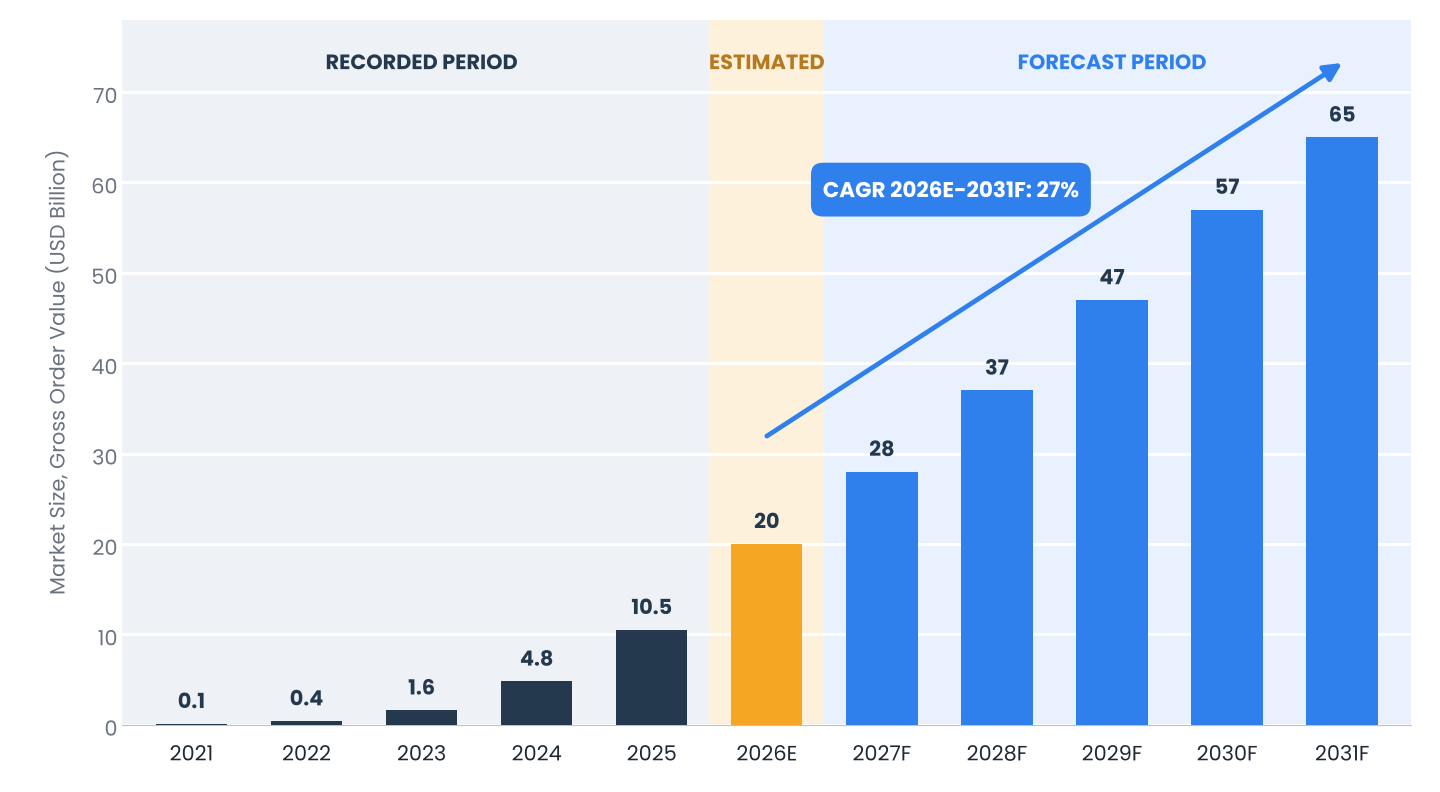
India’s quick commerce market has moved from a metro novelty to a mainstream way to buy groceries and everyday goods. Neargoal Consulting estimates market size, measured as gross order value, at about USD 10.5 billion in 2025, rising to USD 20 billion in 2026E and USD 65 billion by 2031, a 27% CAGR over 2026E-2031F. Blinkit, Zepto and Swiggy Instamart handled more than 1.9 billion orders in FY2025-26 and ended the year with about 4,500 dark stores between them. Growth is tied to profitability, category breadth and reach beyond the largest cities. The research report quantifies the market by Product Category, Business Model, City Tier and Region and shows where the next wave of demand will form.
Key Takeaway Growth is moving from rapid store expansion to profitable density, wider assortment and second-tier city reach. Platforms that improve basket value and delivery cost will capture most of the next USD 45 billion of market value. |
Table 1: India Quick Commerce Market: Key Insights
Metric | Finding |
Market Definition | Gross Order Value of Orders Delivered Through Dark-Store-Based Fast Delivery Platforms in India (USD Billion) |
Base Year / Estimated Year | 2025 / 2026E |
Forecast Period | 2027F-2031F |
Market Size, 2025 | USD 10.5 Billion |
Market Size, 2026E | USD 20 Billion |
Market Size, 2031F | USD 65 Billion |
Forecast CAGR, 2026E-2031F | 27% |
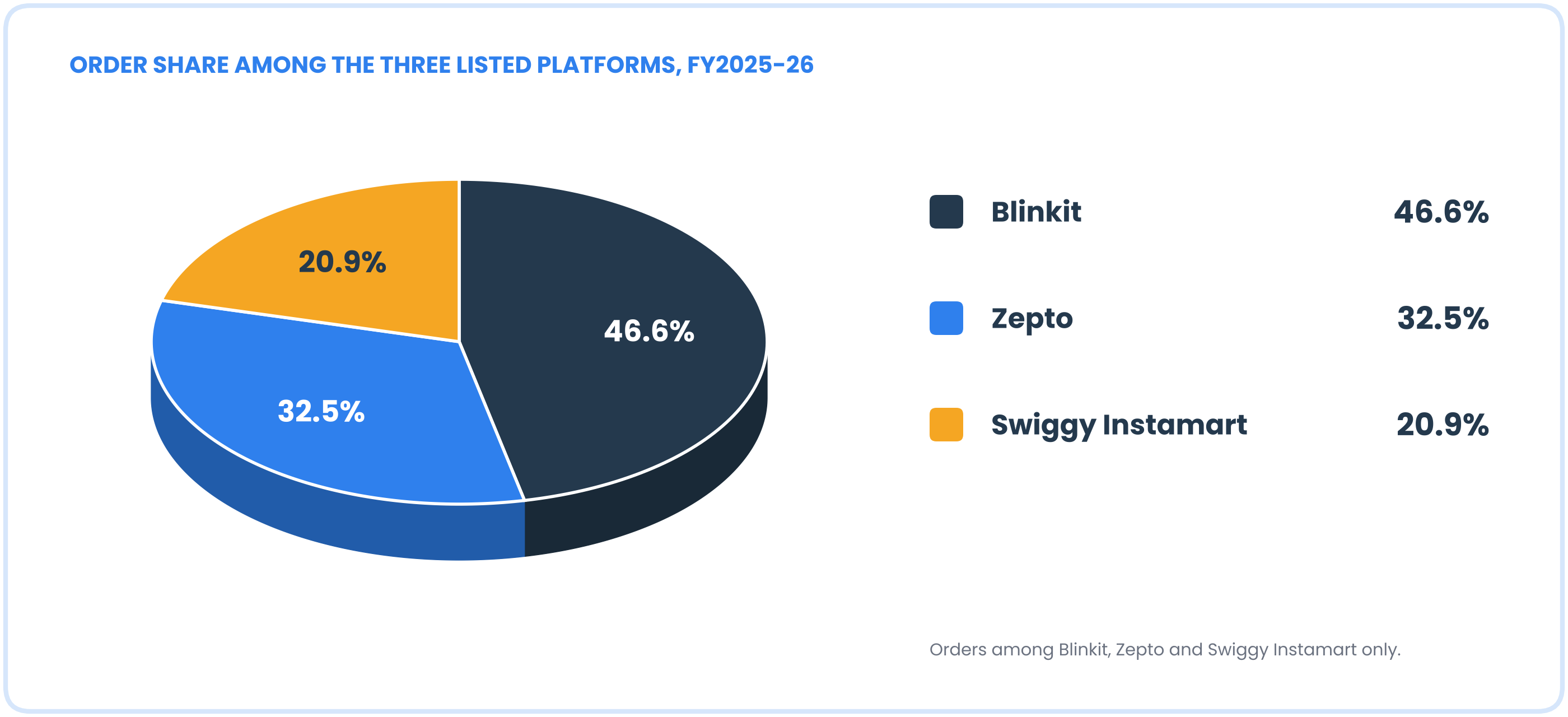
Blinkit Orders, FY2025-26 | 916.6 Million |
Zepto Orders, FY2025-26 | 640.2 Million |
Swiggy Instamart Orders, FY2025-26 | 412.2 Million |
Dark Stores at End of FY2025-26 | 2,243 Blinkit, 1,139 Zepto and 1,143 Instamart |
Leading Category | Grocery and Fresh |
Fastest-Growing Category | Electronics, Home and Beauty |
Key Constraints | Profitability, Delivery Costs and Regulatory Scrutiny |
Source: Neargoal Consulting Analysis | |
Market Outlook
Our study estimates the market will grow at a 27% forecast CAGR (2026E-2031F) from USD 20 billion in 2026E, with annual growth easing from about 40% in 2027F to about 14% in 2031F as the base widens. Our analysis expects growth to come from order frequency, larger baskets and second-tier city expansion, while platform profitability shapes how fast new dark stores open. Blinkit’s net order value reached USD 1.97 billion (INR 171.3 billion) in Q1 FY2026-27, and Zepto’s updated draft prospectus filed in June 2026 shows the scale of capital being raised for expansion.
Figure 1: India Quick Commerce Market Size, 2021-2031F (USD Billion)
Source: Neargoal Consulting Analysis
Figure 2: India Quick Commerce Order Share Among Leading Platforms, FY2025-26
Source: Neargoal Consulting Analysis
Market Dynamics
Growth Drivers
- Convenience and Urban Density. Dense neighborhoods, small homes and dual-income households favor delivery in minutes, which has lifted order frequency from occasional top-ups to routine purchases.
- Dark-Store Expansion. Blinkit ended FY2025-26 with 2,243 dark stores and 2,443 by June 2026, and Zepto plans about 1,900 new dark stores by FY2029-30 using IPO proceeds.
- Category Breadth. Platforms are adding electronics, beauty, home and gifting to groceries, which raises basket size and spreads delivery cost over higher-value orders.
Restraints
- Profitability Pressure. In the March 2026 quarter Blinkit reported adjusted EBITDA of USD 4.25 million (INR 370 million), while Zepto and Instamart reported losses of USD 143 million (INR 12.47 billion) and USD 116 million (INR 10.09 billion).
- Delivery and Labor Costs. Rider availability, working conditions and last-mile costs weigh on unit economics.
- Regulation and Competition. Scrutiny of pricing, dark-store licensing and competition rules, and entry by large e-commerce platforms, add compliance and pricing pressure.
Opportunities
- Second-Tier Cities. Platforms are extending beyond the largest metros, and smaller dark stores can serve compact, dense catchments.
- Higher-Value Categories. Electronics, beauty and home goods carry higher order values and margins than groceries.
- Advertising and Private Labels. Brand advertising and own-label products add high-margin income to delivery fees.
- Brand Partnerships. Consumer brands are creating quick-commerce-specific packs and launches to win shelf space.
Policy and Regulatory Landscape
Quick commerce sits across food safety, consumer protection, labor and competition rules. Dark stores must hold food licenses, platforms face consumer protection rules on pricing and disclosures, and gig-worker welfare rules are evolving at the state and central level. Public listings add disclosure requirements, with Zepto’s updated draft red herring prospectus filed with SEBI in June 2026 and Blinkit’s parent reporting quarterly results.
Segment Insights
By Product Category, grocery and fresh products account for most orders, while higher-value categories grow fastest. The full report quantifies each segment; the highlights below cover Business Model and City Tier.
By Business Model
Inventory-led models, where the platform buys and holds stock in its own dark stores, give control over availability and speed and have been adopted by Blinkit in its shift from a marketplace. Marketplace models rely on partner sellers and need less capital but give less control. Our analysis expects hybrid arrangements to grow as platforms add long-tail categories.
By City Tier
- Top Eight Metros. The core of the market, with the densest dark-store networks and the highest order frequency.
- Second-Tier Cities. The fastest-growing tier, where platforms are testing smaller formats and category mixes suited to local demand.
Geographic Insights
Demand began in Delhi NCR, Mumbai and Bengaluru and is spreading to other metros and second-tier cities as dark-store networks mature.
- Delhi NCR. A dense, early market where platforms test new categories and faster delivery formats.
- Mumbai and Bengaluru. High-income, high-frequency markets where competition for dark-store sites is intense.
- Hyderabad, Chennai, Pune and Kolkata. Established metros where networks are densifying.
- Second-Tier Cities. Newer launches focus on compact catchments and a core assortment.
Competitive Landscape
The market is led by Blinkit, Zepto and Swiggy Instamart. Blinkit handled 916.6 million orders and USD 4.34 billion (INR 377.79 billion) of revenue in FY2025-26, compared with 640.2 million orders and USD 2.6 billion (INR 226.24 billion) for Zepto and 412.2 million orders and USD 443 million (INR 38.59 billion) for Instamart. Large e-commerce and grocery platforms are also in the market, including BigBasket, Flipkart Minutes and Amazon Now. Competition is shifting from speed to assortment, reliability and profitability.
Blinkit | Zepto | Swiggy Instamart | BigBasket |
Flipkart Minutes | Amazon Now | JioMart | DMart Ready |
Logos are trademarks of their respective owners, shown for identification only; no affiliation or endorsement is implied.
Key Developments, 2025-2026
- October 2025. Zepto raises USD 450 million at a USD 7 billion valuation to fund expansion.
- March 2026. Blinkit reports Q4 FY2025-26 net order value of USD 1.65 billion (INR 143.86 billion) and adjusted EBITDA of USD 4.25 million (INR 370 million).
- June 2026. Zepto files an updated draft red herring prospectus for a fresh issue of up to USD 919 million (INR 80.1 billion), with about 1,900 new dark stores planned by FY2029-30.
- July 2026. Blinkit reports Q1 FY2026-27 net order value of USD 1.97 billion (INR 171.32 billion) and adjusted EBITDA of USD 11.7 million (INR 1.02 billion), with 2,443 stores.
What This Means for Decision-Makers
- Platforms: Focus on basket value, density and category mix, not only store counts.
- Consumer Brands: Build quick-commerce-specific packs, ranges and advertising plans.
- Investors: Track contribution margins and order frequency, not gross order value alone.
- Landlords and Logistics Providers: Prepare for demand for compact, well-located dark-store sites.
About the Report
Table 2: India Quick Commerce Market: Report Coverage
Coverage Area | What the Report Covers |
Market Size and Forecast | Gross Order Value (USD Billion) and Order Views, 2021-2031F |
Segmentation | Product Category, Business Model, City Tier and Region |
Geography | Delhi NCR, Mumbai, Bengaluru, Other Metros and Second-Tier Cities |
Competition | Platforms, Order Volumes, Dark-Store Networks and Profitability |
Policy and Regulation | Food Licensing, Competition Rules, Labor Welfare and Listing Disclosures |
Outlook and Recommendations | White-Space Assessment and Guidance by Stakeholder |
Source: Neargoal Consulting Analysis | |
The research report, India Quick Commerce Market Outlook 2021-2031F - Market Size, Share, Trends, Opportunities, and Competitive Analysis - Segmented by Product Category (Grocery and Fresh, Electronics and Home, Beauty and Personal Care, and Others); Business Model (Inventory-Led and Marketplace); City Tier (Top Eight Metros, and Second-Tier Cities); and Region, covers orders delivered by dark-store-based fast delivery platforms in India, measured by gross order value, with a 2025 base year, a 2026E estimate and a 2027F-2031F forecast. It excludes scheduled grocery delivery, restaurant food delivery and general e-commerce. Market estimates and projections are based on Neargoal Consulting’s proprietary research methodology, exhaustive primary and secondary research.
For questions about report coverage, methodology, suitability, etc.
For requirements beyond the published report