Germany Specialty Chemicals Market to Reach USD 63 Billion by 2031: Neargoal Consulting Finds Energy Relief and Higher-Value Products Driving a Gradual Recovery
Market value is set to grow about 20% from 2026E as electronics and construction demand returns
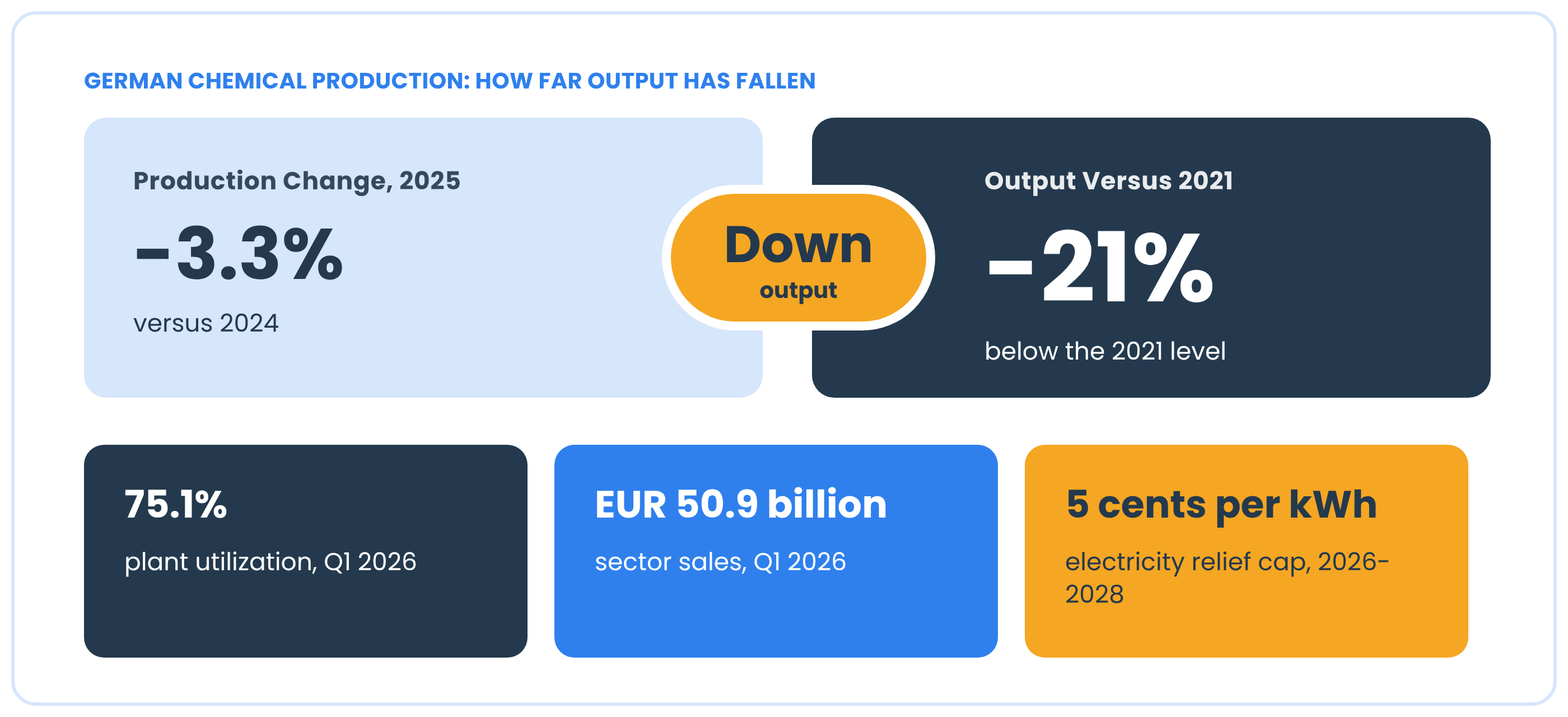
Germany Specialty Chemicals Market Outlook 2021-2031F, a research report published by Neargoal Consulting, projects the Germany specialty chemicals market to reach USD 63 billion by 2031, up from USD 53 billion in 2025 and USD 54 billion in 2026E. The market is expected to grow at a 3% CAGR over 2026E-2031F after a -1% CAGR over 2021-2025, as electricity relief, a shift to higher-value products and demand in electronics and construction offset weak volumes. German plant utilization was 75.1% in Q1 2026.
Figure 1: Germany Specialty Chemicals Market Snapshot, 2025-2031F
Source: Neargoal Consulting Analysis
Key Findings
1. Market Outlook. The market is projected to rise from USD 53 billion in 2025 to USD 54 billion in 2026E and USD 63 billion by 2031F, a 3% CAGR over 2026E-2031F.
2. Electricity Relief Supports Producers. The scheme caps eligible power costs at 5 cents per kWh from 2026 to 2028, though the sector association says it covers less than 10% of electricity purchase costs for most firms.
3. Performance Additives and Coatings Lead. These product groups hold the largest share of value, supported by automotive, construction and industrial customers.
4. Electronics Is the Fastest-Growing End Use. Semiconductor and battery investment supports demand for high-purity and advanced materials.
5. Rhine-Ruhr and Rhineland-Palatinate Anchor Output. North Rhine-Westphalia and Rhineland-Palatinate host the largest integrated chemical sites.
6. Costs Remain the Main Constraint. The industrial power price index was 309 points in March 2026, and naphtha rose almost 18% in Q1 2026.
7. Competition Is Shifting to Differentiation. Producers are closing commodity assets, focusing on specialties and expanding in Asia.
Market Landscape
German specialty chemicals sit between a weak industrial economy and a global shift in chemical capacity. Production fell 3.3% in 2025 and was about 21% below 2021, and about 471,500 people worked in the sector in Q1 2026, roughly 1% fewer than a year earlier. China accounted for 45.7% of global chemical turnover in 2024, and plants amounting to about 25% of German capacity have closed since 2022. Specialty producers are better placed than commodity peers, since technical formulations and customer proximity support pricing, but the pace of recovery depends on energy costs and on demand in construction, automotive and electronics. Costs set the pace. Crude oil averaged more than USD 80 per barrel in Q1 2026 and exceeded USD 100 as Middle East tensions escalated, incoming orders remain more than 20% below the 2021 level, and 82% of companies are passing higher costs on to customers. Chemical manufacturing used 42.79 TWh of electricity in 2024, about 9% of German electricity use, so power prices matter more than for most industries.
Segment Spotlight: Performance Additives, Coatings and Electronic Materials
By product, performance additives and coatings form the largest group, serving automotive, construction, industrial and consumer customers. The segment depends on construction renovation and automotive production, both of which remain weak, but technical performance and regulatory shifts toward low-emission formulations support value.
Electronic and advanced materials are the fastest-growing group, supported by semiconductor, battery and electronics investment in Europe. High-purity chemicals, specialty gases and battery materials need close customer relationships and stringent quality, which suit German producers. The study examines how each product group performs across end uses and states, and where energy intensity makes capacity vulnerable.
Regional Outlook
Production is concentrated in integrated chemical parks. North Rhine-Westphalia is the largest by output, supported by dense raw material and customer networks, and Rhineland-Palatinate hosts the largest integrated site. Bavaria focuses on specialty production for electronics, construction and consumer end uses, while Saxony-Anhalt offers eastern clusters with room for new investment.
Key Developments
Electricity. The federal government agreed industrial electricity price relief of up to 5 cents per kWh for 2026-2028 with a EUR 3.8 billion budget.
Capacity. BASF opened its Zhanjiang site in China in March 2026 after investment of EUR 8.7 billion, a sign of investment shifting abroad.
Demand. Sector sales were EUR 50.9 billion in Q1 2026, and the industry association withheld a full-year forecast.
Why It Matters
Recovery will be slow and selective. Orders remain more than 20% below 2021 levels, and costs for energy and raw materials are rising again. Producers, customers, lenders and policymakers that understand which specialty niches can hold margin, and which sites are at risk, will be better placed to allocate capital.
Report Coverage
Key participants shaping the market include BASF, Evonik, Lanxess, Wacker Chemie, Merck KGaA, Symrise, Covestro, Altana and Heraeus, among others.
The research report, Germany Specialty Chemicals Market Outlook 2021-2031F - Market Size, Share, Trends, Opportunities, and Competitive Analysis - Segmented by Product (Performance Additives and Coatings, Electronic and Advanced Materials, Construction and Care Chemicals, and Others); End Use (Automotive, Construction, Electronics, Consumer and Personal Care, and Others); State (North Rhine-Westphalia, Bavaria, Baden-Wurttemberg, Rhineland-Palatinate, and Others); and Region, covers market size and forecast, segmentation, state-level analysis, policy and costs, competitive landscape and company profiles. Market estimates and projections are based on Neargoal Consulting’s proprietary research methodology, exhaustive primary and secondary research.
To request a sample or the full table of contents, visit neargoal.com.
About Neargoal Consulting
Neargoal Consulting is a market intelligence and advisory firm delivering analyst-led, evidence-validated research across Energy, Chemicals, Automotive & EV, Digital Technologies, Consumer & Retail, Healthcare, and Defense. Every engagement is built around the decision it needs to support. For more information, visit neargoal.com.